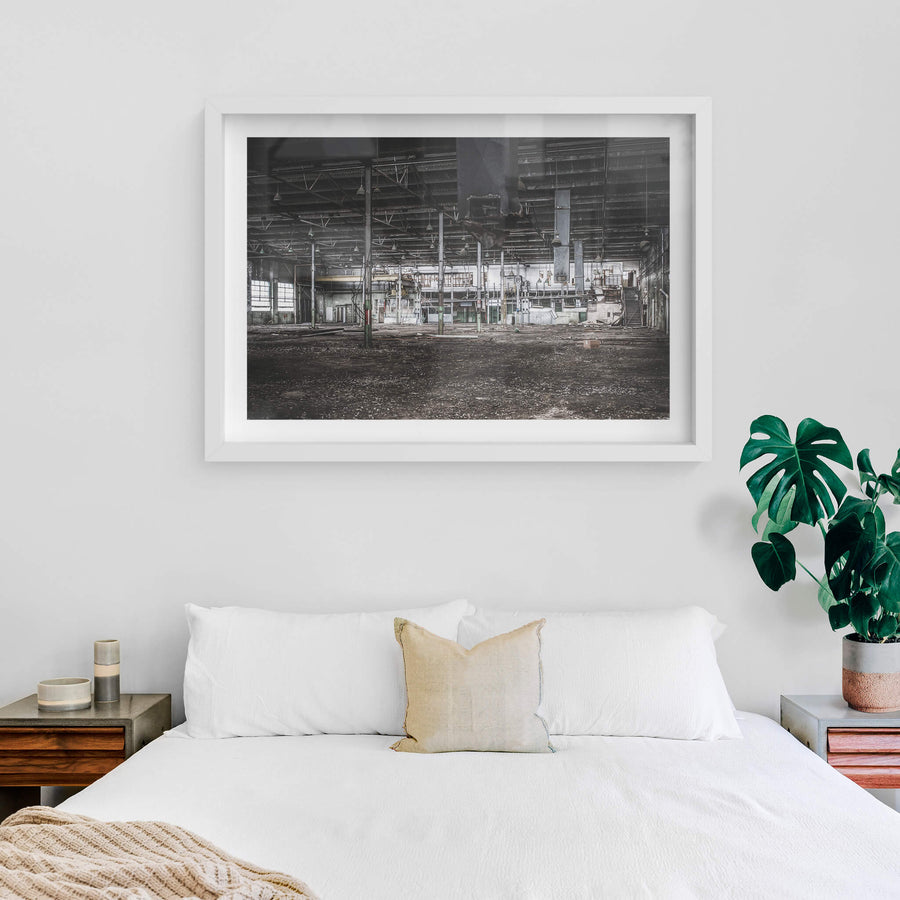
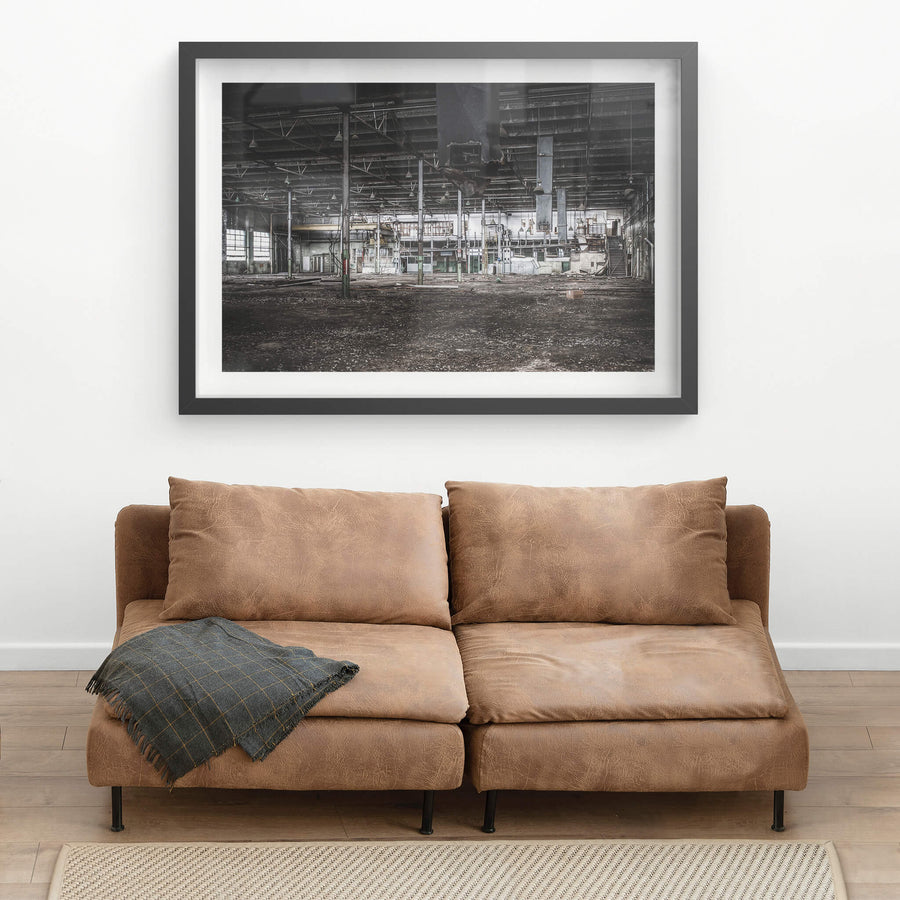
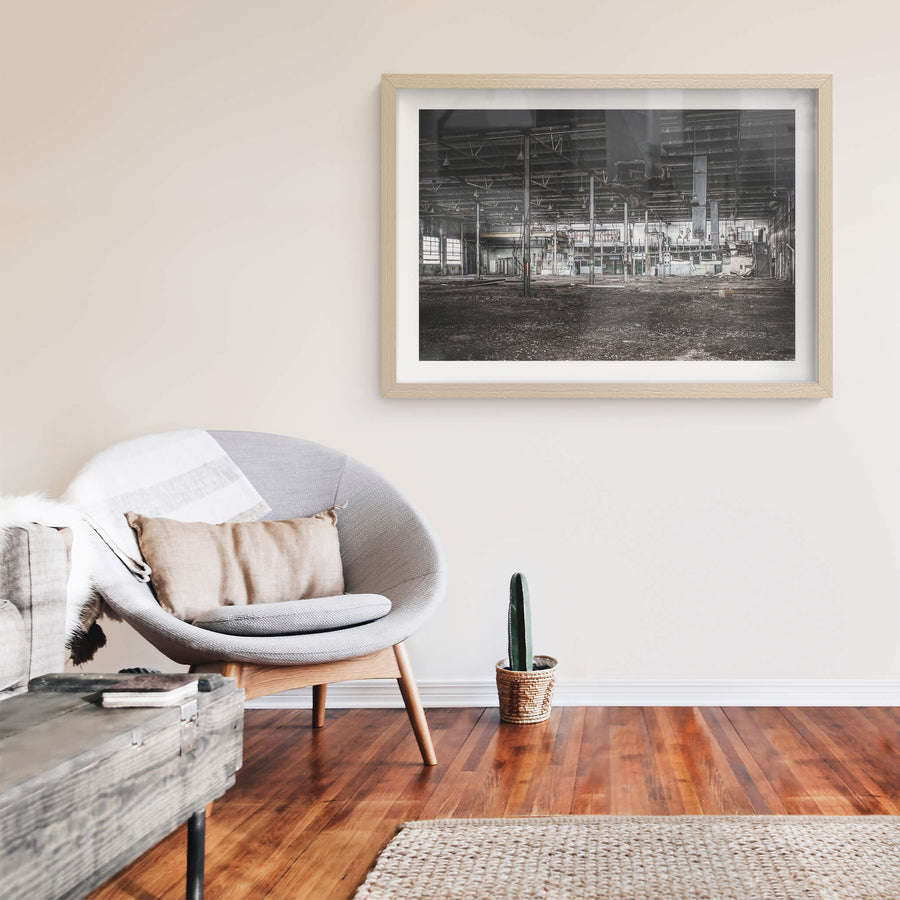
Factory Floor

Provenance

Camera
NIKON D7000
Lens
AF-S Zoom-Nikkor 24-70mm f/2.8G ED
Settings
36mm · f/4.0 · 1/10 · ISO 250
Paper
Ilford Galerie Smooth Cotton Rag 310 gsm

A vast factory floor, empty and unlit except for natural light entering through a row of high windows. Rusting machinery stands in place across the floor. Surfaces show advanced oxidation. No materials, product, or workers remain. The scale of the space is evident in the receding depth of the frame.

Edition
Open edition

Open edition
Printed to order, no fixed quantity. Each print is hand-signed by the photographer.

Limited edition
A fixed number of prints exist. Once sold, the edition closes permanently. Each print is individually numbered and signed.

$100.00 AUD
Size
Type
Colour
Signed, numbered, with COA. Made to order in 5 to 10 business days (unframed). Shipped in protective packaging with edition certificate, paper-stock reference and a printed care guide.
See certificate sample →

Shipping Free shipping over $250. Ships worldwide, rates calculated at checkout.

Returns Damaged in transit? We replace it. Full policy →

Ships within 10 business days · signed & numbered

In situ
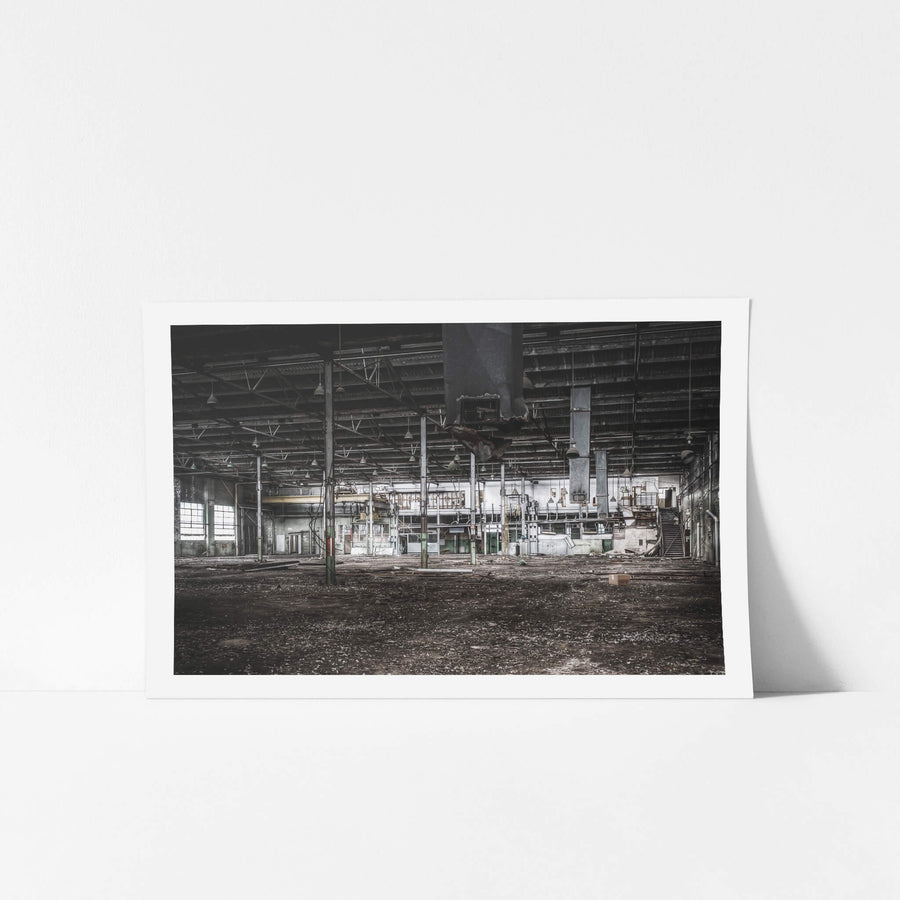
Factory Floor at O-I Glass, unframed print displayed in situ on a wall.Factory Floor at O-I Glass, white-framed print displayed in situ on a wall.Factory Floor at O-I Glass, black-framed print displayed in situ on a wall.Factory Floor at O-I Glass, raw timber-framed print displayed in situ on a wall.Factory Floor at O-I Glass, glass print displayed in situ on a wall.
01 PROVENANCE

Print datasheet

Title
Factory Floor
Series
O-I Glass
Catalogue
OIG-005
Process
Giclée
Captured
18 December 2011
Camera
NIKON D7000
Lens
AF-S Zoom-Nikkor 24-70mm f/2.8G ED
Aperture
f/4.0
Shutter
1/10 s
ISO
250
Focal length
36 mm
Paper
Ilford Galerie Smooth Cotton Rag 310 gsm
Paper size
290 × 200 mm
Location
Thomastown, Victoria, Australia
Recognised by
Highly Commended in Multimedia at the 2016 National Trust of Australia (NSW) Heritage Awards
02 LOCATION

Thomastown, Victoria, Australia

Map · Mapbox · OpenStreetMap

03 THE STORY

About this print

The factory floor of the former Melbourne Glass Bottle Works at Spotswood is a large, open industrial space running the length of a building designed around continuous production. High windows line the upper walls, and in 2011 the light they admitted fell across machinery left standing where it had last been used. Rust had taken hold across most metal surfaces. Nothing had been cleared. The floor held the evidence of a manufacturing operation that had simply stopped. Glass production at Spotswood began in 1890, when the Melbourne Glass Bottle Works Company purchased 12 acres on the Yarra and built a new plant to replace the original Graham Street, Emerald Hill works established in 1872. A branch railway siding connected the site to Spotswood station; a jetty on the river handled shipping. By 1908 the factory was producing 27 million bottles annually, consuming 20 tons of sand and 4 to 6 tons of lime and soda every day. Workers gathered molten glass on 5-foot iron tubes, rolled it on metal marvers, and shaped it in hinged moulds. The company amalgamated with the Waterloo Glass Bottle Manufacturing Company in 1915 to form Australian Glass Manufacturers (AGM), with Spotswood as headquarters. AGM became Australian Consolidated Industries (ACI) in 1939, and the site continued producing glass containers under that name through the following decades. Owens-Illinois (O-I) completed its acquisition of the BTR Packaging group, which then held ACI Glass Packaging, in April 1998. The plant closed in January 2012. All factory buildings were demolished shortly after closure. The heritage listing the site carried, a local-level overlay under the Hobsons Bay Planning Scheme, did not prevent demolition. The basalt wall on Douglas Parade, 115 metres long and 6 metres high and known to workers as the Great Wall of Spotswood, is the only above-ground remnant. This photograph records the factory floor as it stood in 2011, machinery in place, the building still intact.

04 FROM THE FIELD NOTES

The factory floor of the former Melbourne Glass Bottle Works at Spotswood once supported one of Australia's largest glass manufacturing operations. By 1908 the site produced 27 million bottles annually. Light from high windows falls across rusting machinery that has not moved since production wound down. The plant closed in January 2012, and all buildings were demolished shortly after. This photograph records what remained on the floor before the demolition crews arrived.

Brett Patman

O-I Glass

The series

O-I Glass

2011 · 15 photographs

Alfred Felton and Frederick Grimwade founded the Melbourne Glass Bottle Works in 1872 at Graham Street, Emerald Hill, to supply their wholesale drug business. In 1890 the company purchased 12 acres on the Yarra at Spotswood and built the new manufacturing plant that would carry on glass production for over a hundred years, through Australian Glass Manufacturers, Australian Consolidated Industries, BTR and Owens-Illinois. The site was demolished by 2012, with only the 115-metre basalt wall on Douglas Parade, known to the workers as the Great Wall of Spotswood, left standing.

View all in this series →

05 SIZE GUIDE

Print sizes

The anatomy view shows what this finish is as a physical object: paper margin, mat band, frame depth, acrylic profile. The comparison strip shows how each size sits relative to the others at true scale. Click a size or a finish to update both.

Anatomy · true ratio
TypeSizeWidthHeight
08 BY POST · NO SPAM

Read the full story

Articles when they're published. The history behind a place. The day of a shoot. The work between prints. No marketing, no schedule.

You're subscribed.