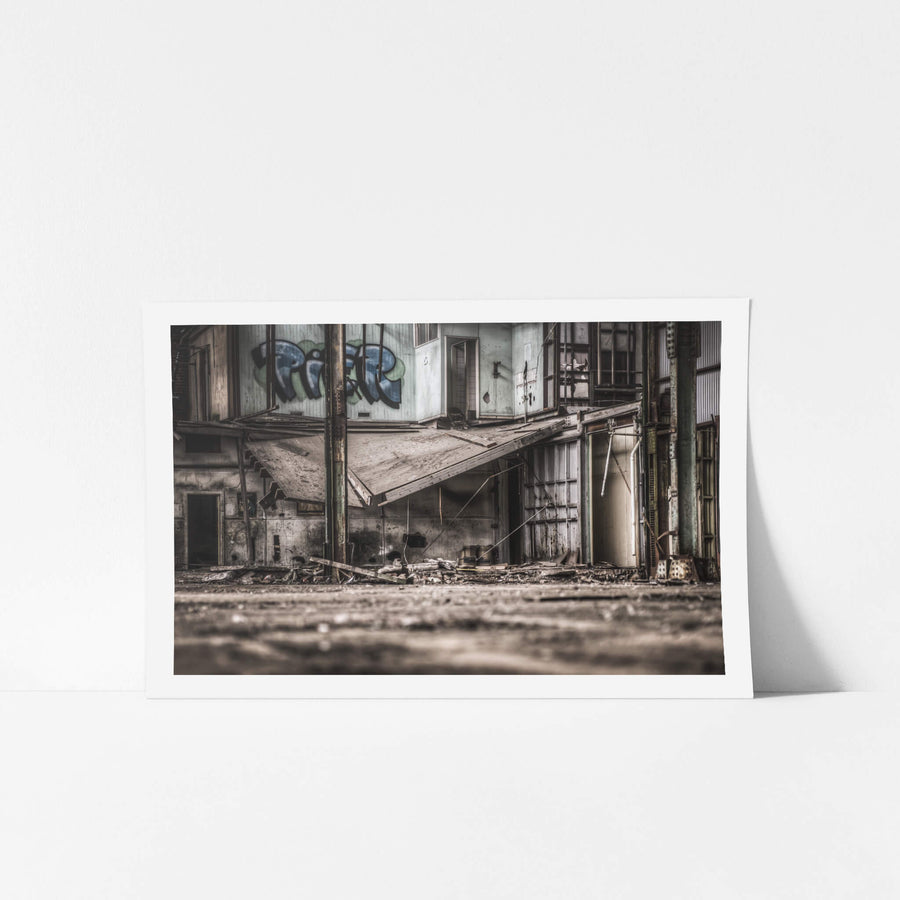
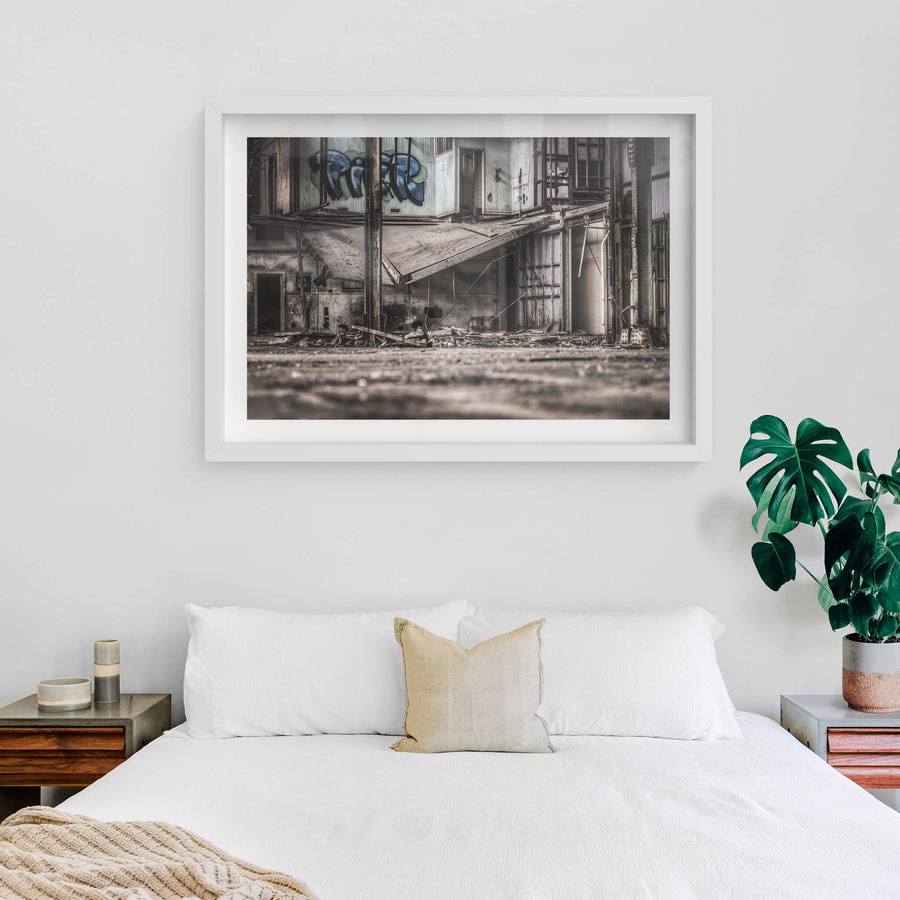
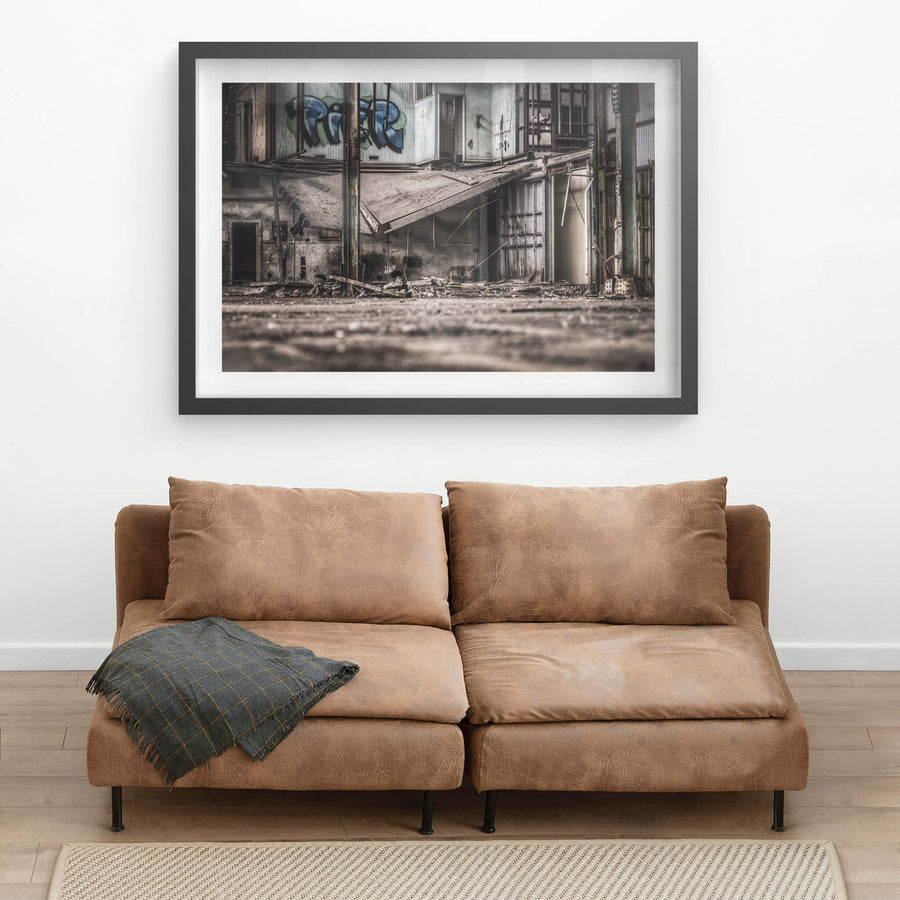
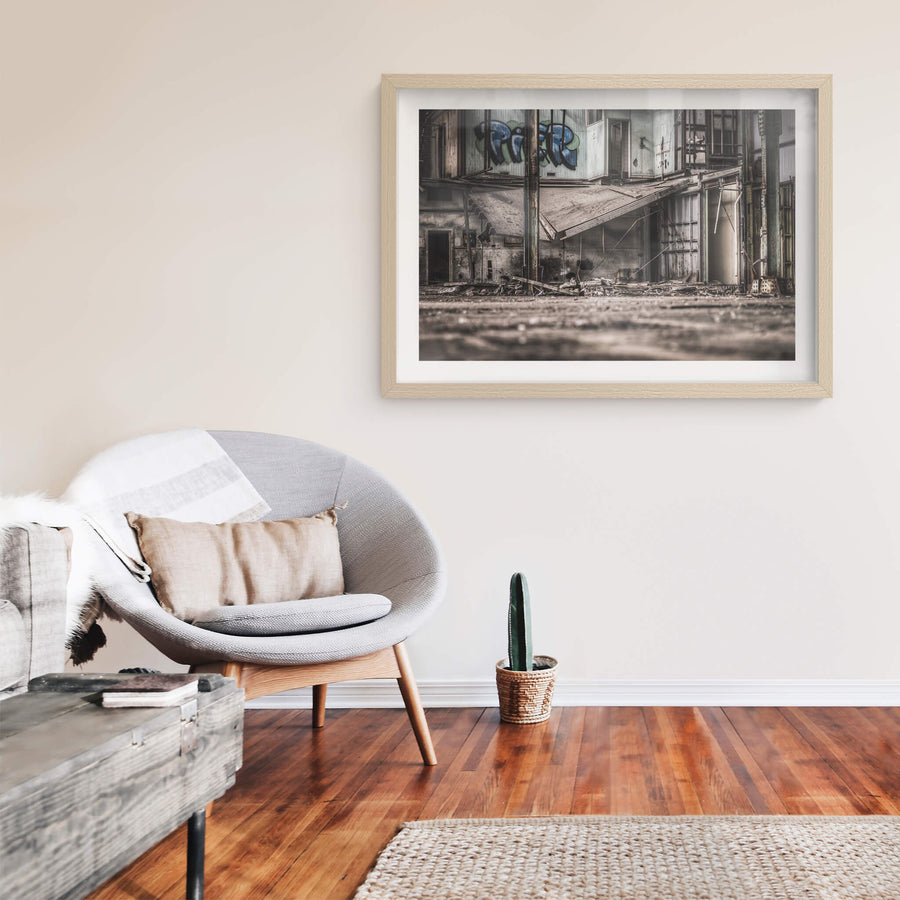
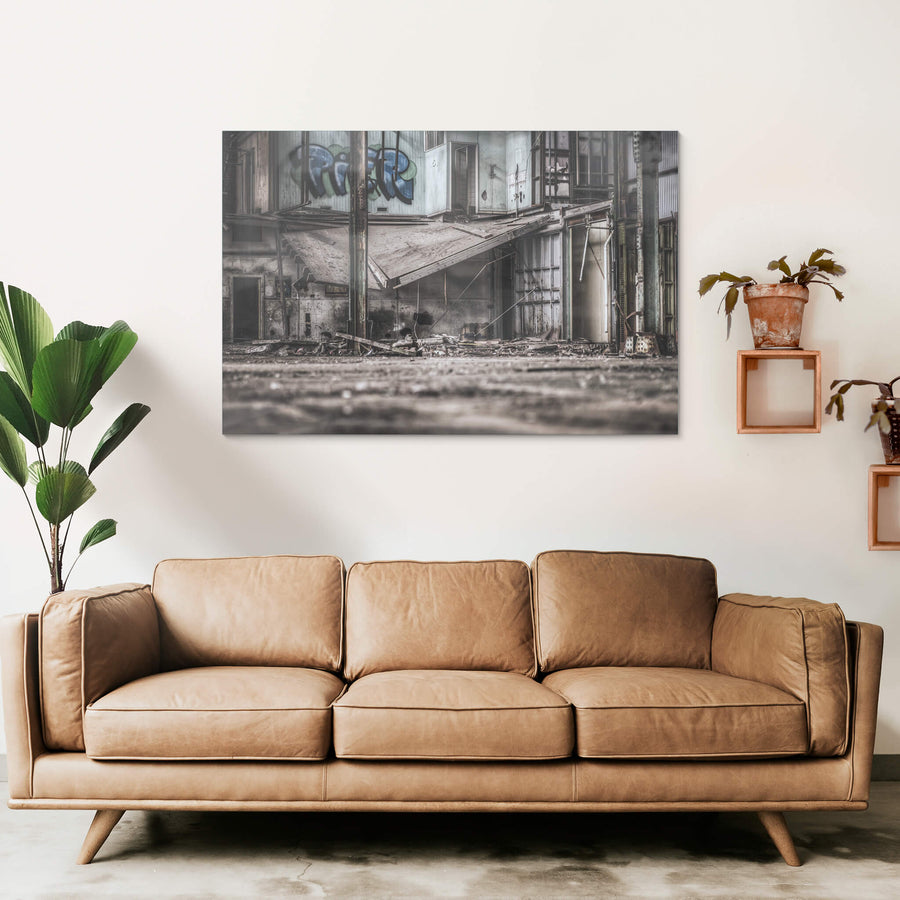
Rusted vertical beams line the walls of the loading bay, their paint peeling in long strips. Overhead, a wooden ceiling structure has partially collapsed and tilts at a steep angle. The concrete floor is thick with broken planks and scattered debris. Blue and green graffiti reading Pier marks a pale wall at the far end.
Edition
Open edition
Open edition Printed to order, no fixed quantity. Each print is hand-signed by the photographer.
Limited edition A fixed number of prints exist. Once sold, the edition closes permanently. Each print is individually numbered and signed.
$100.00 AUD
Size
Type
Colour
✓
Signed, numbered, with COA. Made to order in 5 to 10 business days (unframed). Shipped in protective packaging with edition certificate, paper-stock reference and a printed care guide.
Rusted vertical beams line the walls of the loading bay at the former Melbourne Glass Bottle Works at Spotswood, their paint peeling in long strips. Overhead, a wooden ceiling structure has partially collapsed and tilts at a steep angle. The concrete floor is thick with broken planks and scattered debris, and blue and green graffiti reading Pier marks a pale wall at the far end. The photograph was made in 2011, months before demolition removed every building on the site. Glass had been produced on this Spotswood site since 1890, when the Melbourne Glass Bottle Works Company purchased 12 acres on the Yarra and built its first plant. A branch railway siding connected the works to Spotswood station; a jetty served river shipping. By 1891 the factory employed approximately 120 workers and ran continuously day and night. By 1908 it was producing 27 million bottles a year, handling 20 tons of sand daily alongside lime and soda, and had expanded to include a Port Melbourne branch for beer bottles and imperial pints. The company amalgamated with the Waterloo Glass Bottle Manufacturing Company in 1915 to form Australian Glass Manufacturers. In 1939 that entity became Australian Consolidated Industries, which diversified over the following decades into plastics, packaging, and building products. BTR plc acquired the business around 1987; Owens-Illinois completed its acquisition of BTR Packaging in April 1998, folding the Spotswood site into the world's largest glass container manufacturer. A 19-week lockout of maintenance workers in 1996 and 1997 was the final industrial rupture before manufacturing wound down. The factory closed in January 2012. Buildings that heritage assessors had described as the oldest continuously operating industrial complex in the city were demolished, the site paved over. Only the basalt wall, 115 metres long and 6 metres high, was preserved. The loading bay, the beams, the peeling paint: gone. The photograph is what remains.
04·FROM THE FIELD NOTES
Rusted vertical beams line the walls of the loading bay, their paint peeling in long strips.
Brett Patman
The series
Graffiti & Urban Decay
54
photographs
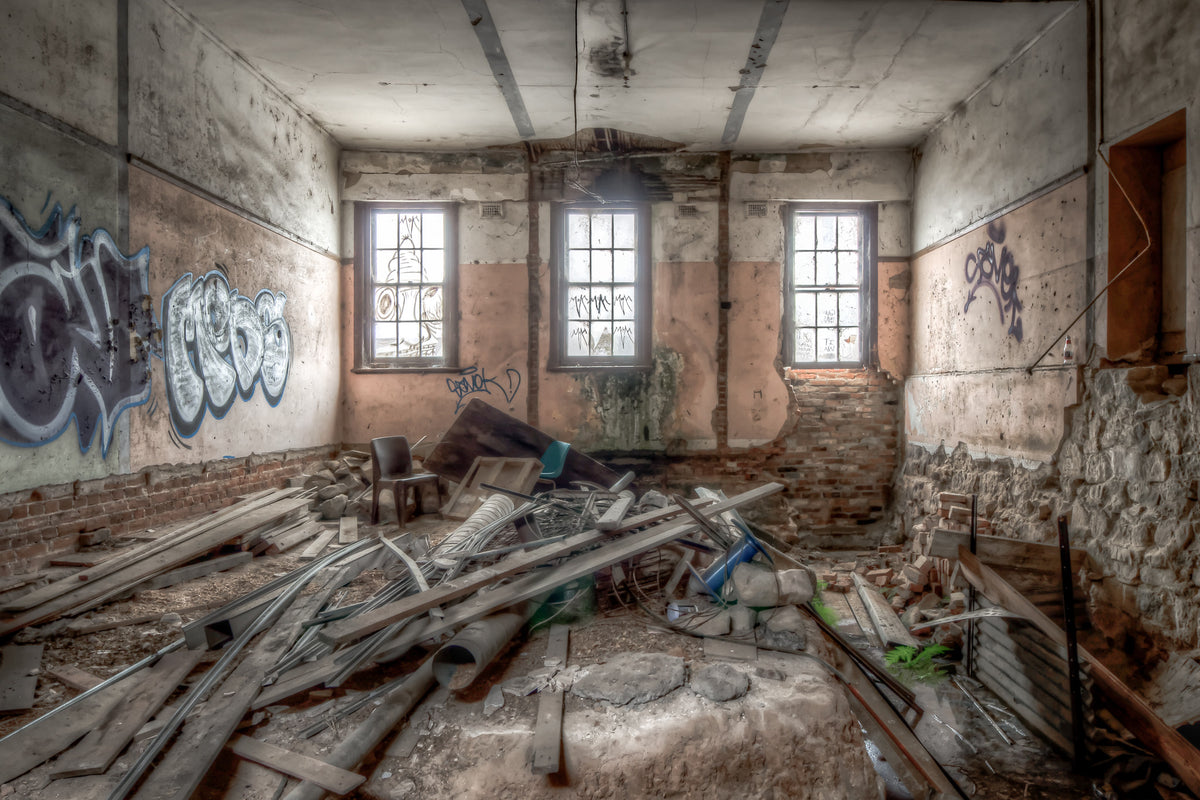
Buildings don't stay empty. Once the owners leave, somebody else arrives. Walls that were blank become a record of who came through and when. Graffiti isn't vandalism on these surfaces , it's the only remaining evidence that anyone cared enough to be here.Urban spaces mid-collapse. The gap between what a building was built for and what it became.
The anatomy view shows what this finish is as a physical object: paper margin, mat band, frame depth, acrylic profile. The comparison strip shows how each size sits relative to the others at true scale. Click a size or a finish to update both.