
Footbridge
Provenance
- Camera
- NIKON D810
- Lens
- 14.0-24.0 mm f/2.8
- Settings
- 14mm · f/22.0 · 1/100 · ISO 100
- Paper
- Ilford Galerie Smooth Cotton Rag 310 gsm
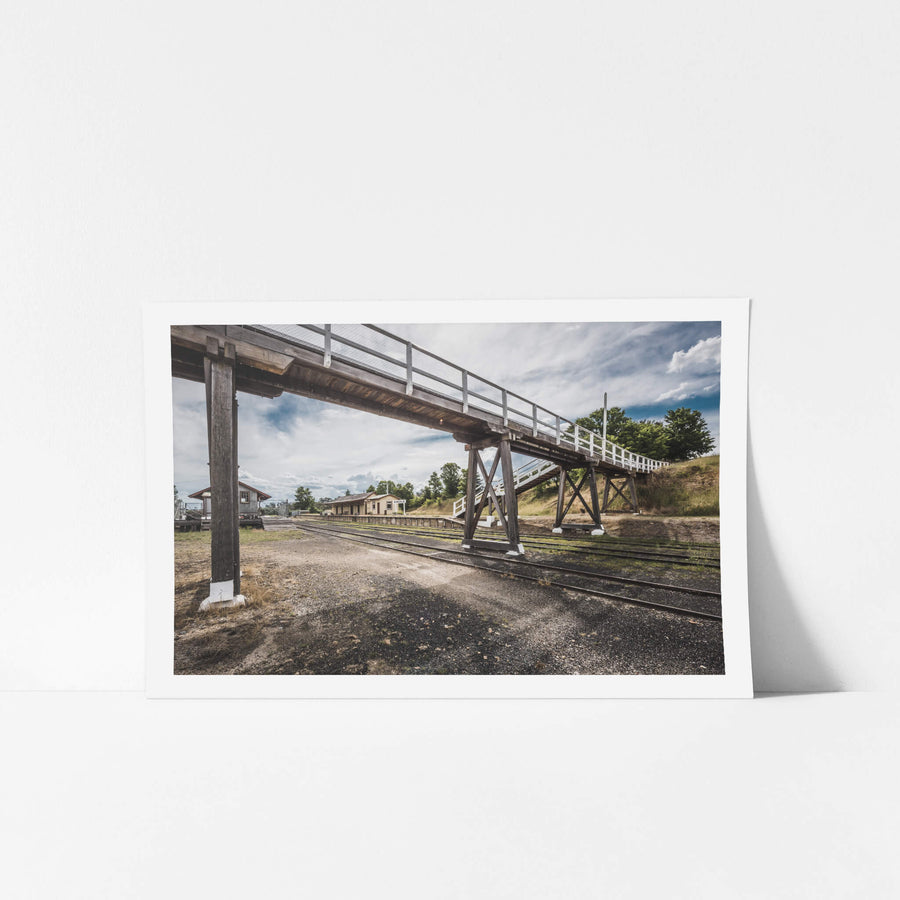
Ironbark planking and white-painted railings carry the footbridge across the tracks at Bombala Railway Station, the station building and its nameboard closing the view beneath a broken sky. Large upright timber posts anchor the structure in the foreground, and light gravel and darker ballast fill the gaps between the rails below. The bridge runs well past the platform edge toward open ground on the far side of the yard.
Open edition
Printed to order, no fixed quantity. Each print is hand-signed by the photographer.
Limited edition
A fixed number of prints exist. Once sold, the edition closes permanently. Each print is individually numbered and signed.
Shipping Free shipping over $250. Ships worldwide, rates calculated at checkout.
Returns Damaged in transit? We replace it. Full policy →
Ships within 10 business days · signed & numbered
In situ
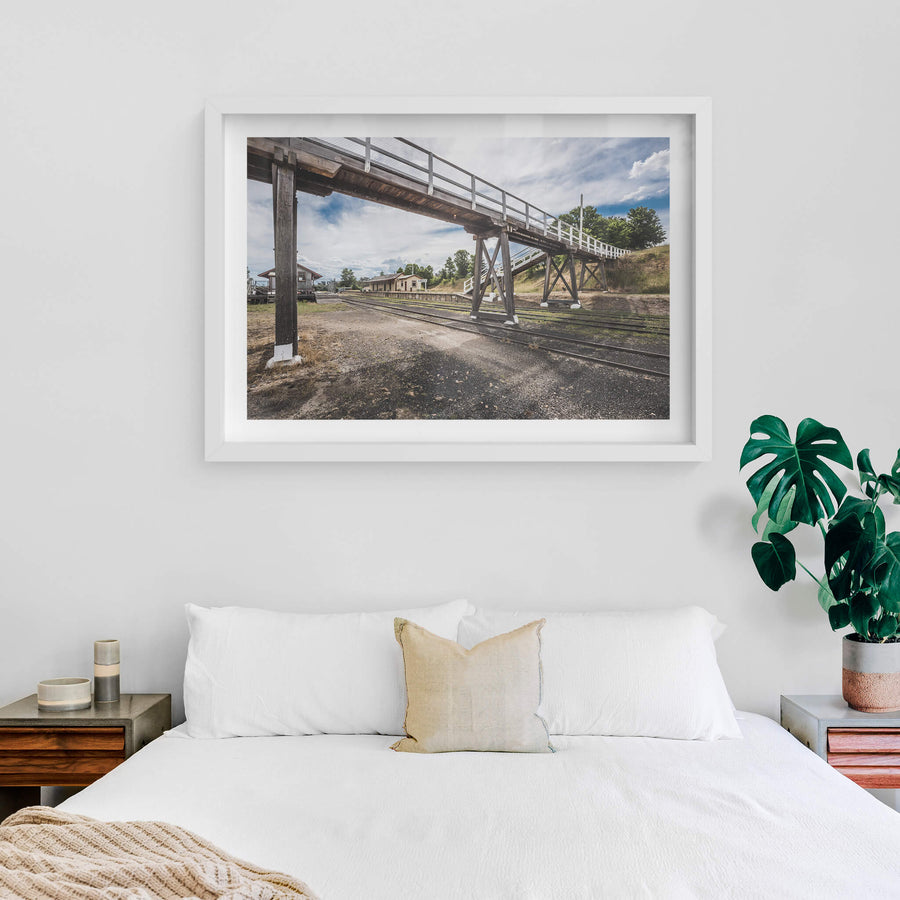
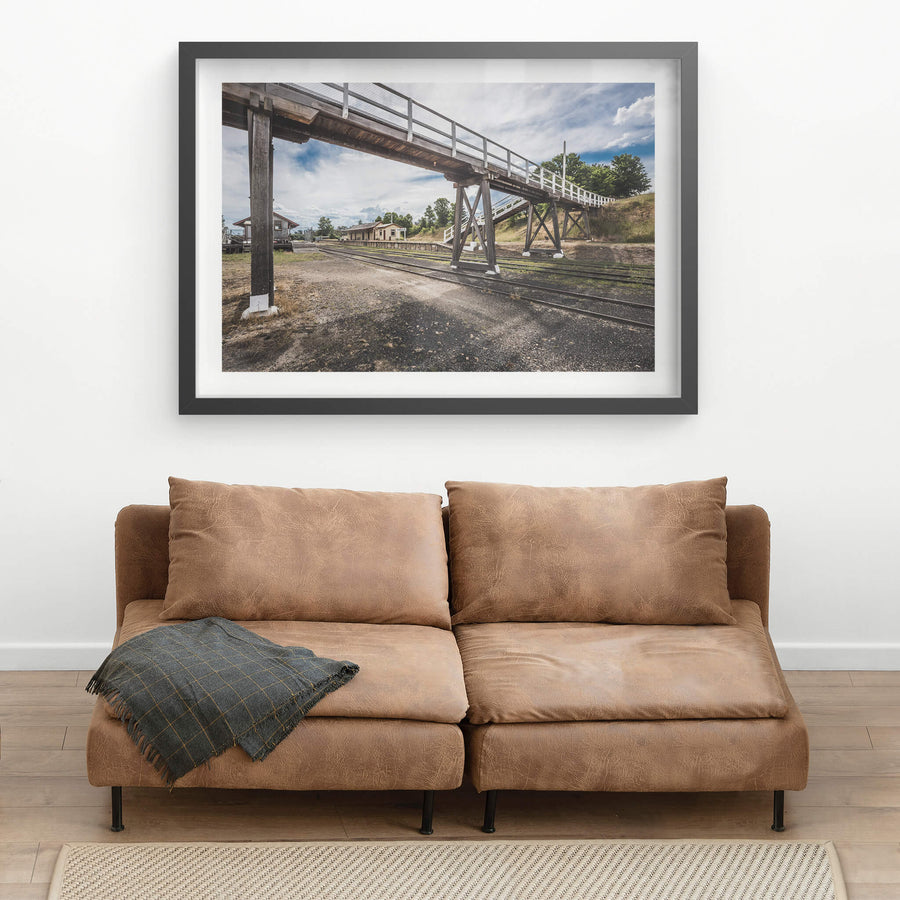
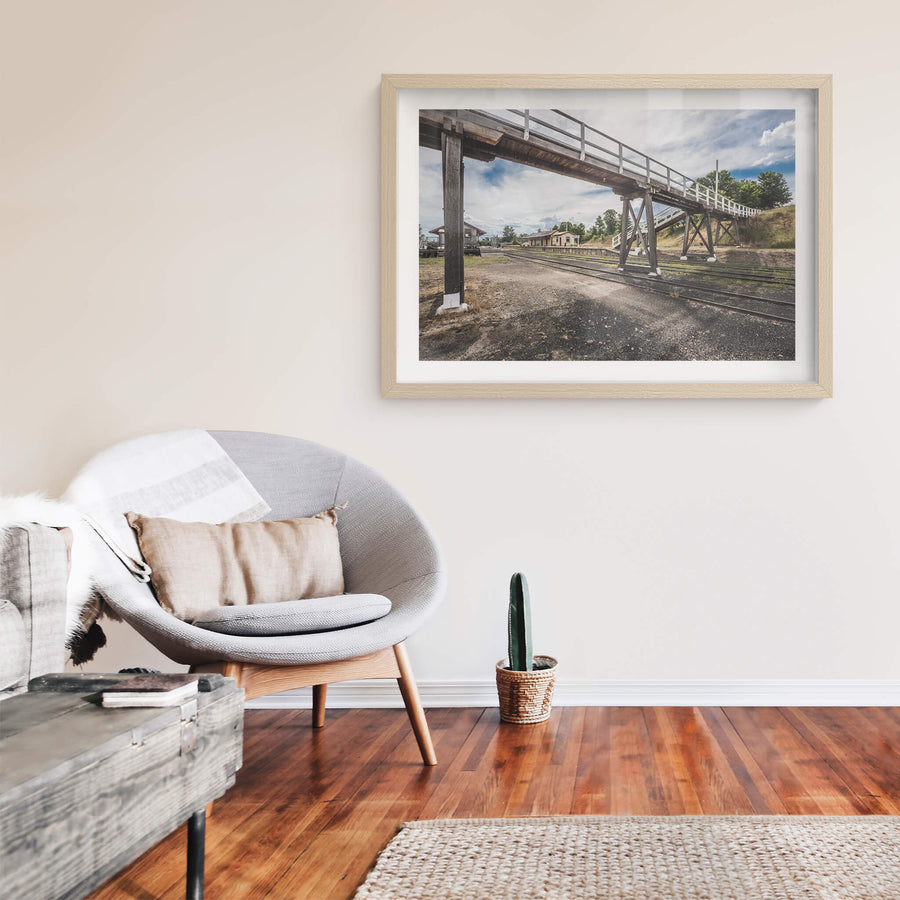
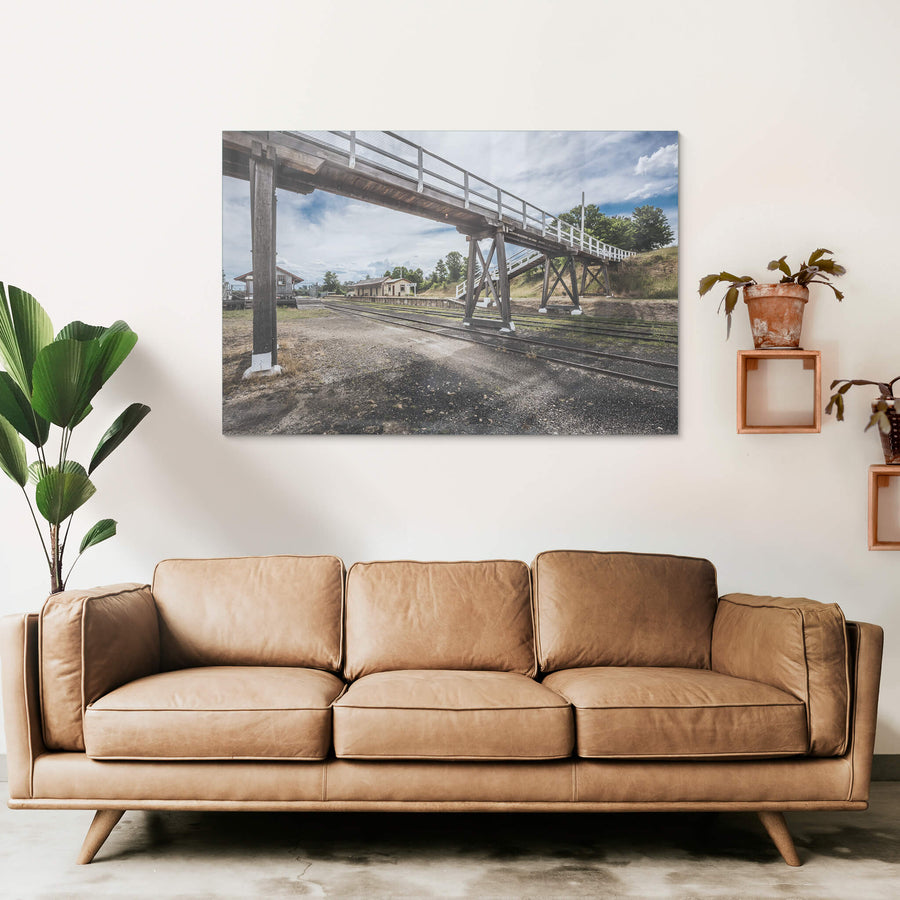
Print datasheet
- Title
- Footbridge
- Series
- Bombala Station
- Catalogue
- BST-005
- Process
- Giclée
- Captured
- 26 December 2016
- Camera
- NIKON D810
- Lens
- 14.0-24.0 mm f/2.8
- Aperture
- f/22.0
- Shutter
- 1/100 s
- ISO
- 100
- Focal length
- 14 mm
- Paper
- Ilford Galerie Smooth Cotton Rag 310 gsm
- Paper size
- 297 × 210 mm
- Location
- Bombala, New South Wales, Australia
- Authenticity
- C2PA verified provenance →
- Recognised by
- Highly Commended in Multimedia at the 2016 National Trust of Australia (NSW) Heritage Awards
Bombala, New South Wales, Australia
Map · Mapbox · OpenStreetMap
About this print
The timber footbridge at Bombala Railway Station stands 30 metres from the main building, reaching across the yard toward open ground with no structure on the far side to justify it. Heritage NSW describes it as a superb example of a non-standard solution to site access, and the only footbridge of its type built at a rural terminus in NSW. It was constructed in 1921, the same year the station opened, and allowed residents to cross the working yard safely. It remains one of the most distinctive elements of a site that Heritage NSW describes as one of the most intact country terminus stations in the state.
Brett Patman

The series
Bombala Station
Bombala railway station is the terminus of the Goulburn-Bombala branch line, sitting at the southern end of the Monaro in NSW, near the Victorian border. The Nimmitabel to Bombala section opened on 21 November 1921, and every building in the yard dates from that year: the pre-cast concrete station building, signal box, goods shed, footbridge, turntable, gantry crane, cattle yard, and barracks. The last passenger service ran in August 1974. The last goods train rolled out on 26 March 1986. Listed on the NSW State Heritage Register (item 5011934, 2 April 1999), the station is described as one of the most intact country terminus sites from the 1920s railway expansion, with the station building rated as one of the best surviving pre-cast concrete structures in NSW. The Friends of Bombala Railway maintain the precinct as a heritage museum.
Print sizes
The anatomy view shows what this finish is as a physical object: paper margin, mat band, frame depth, acrylic profile. The comparison strip shows how each size sits relative to the others at true scale. Click a size or a finish to update both.
| Type | Size | Width | Height |
|---|


