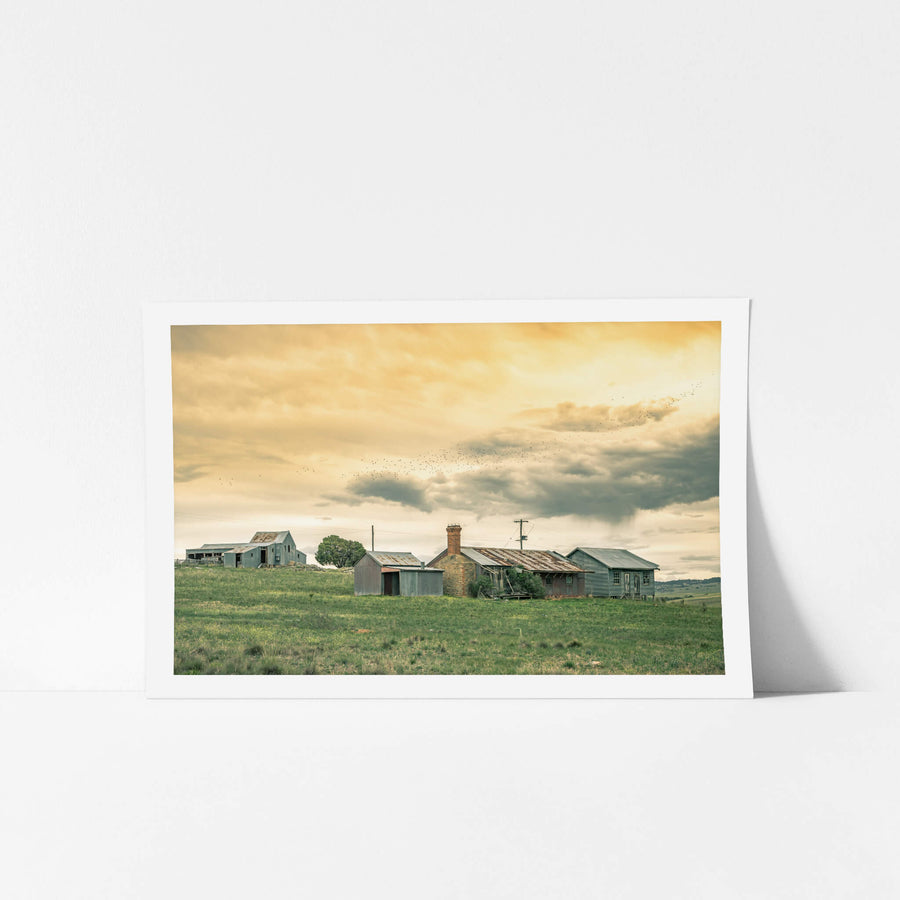
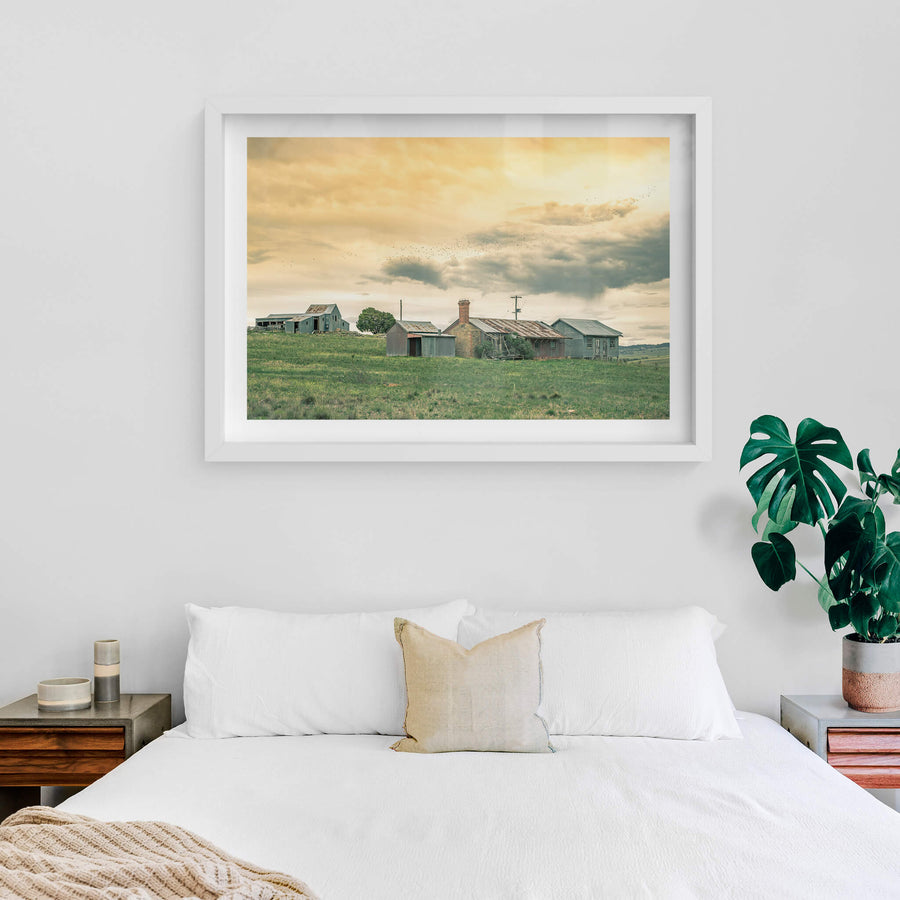
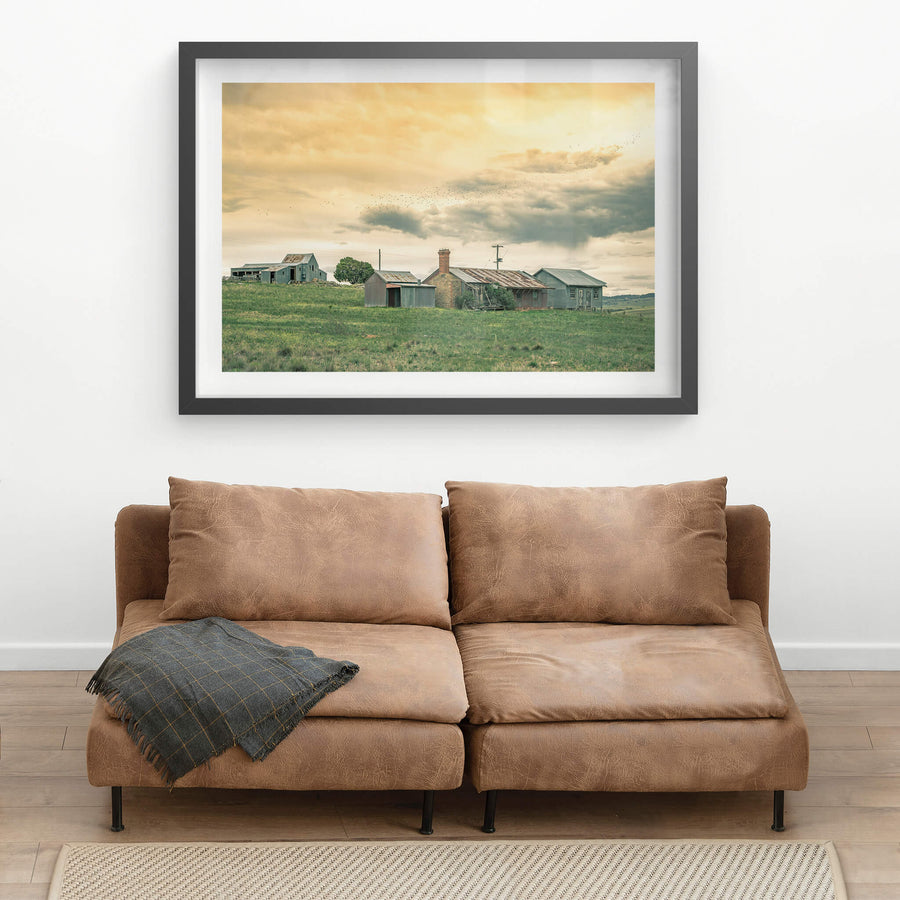
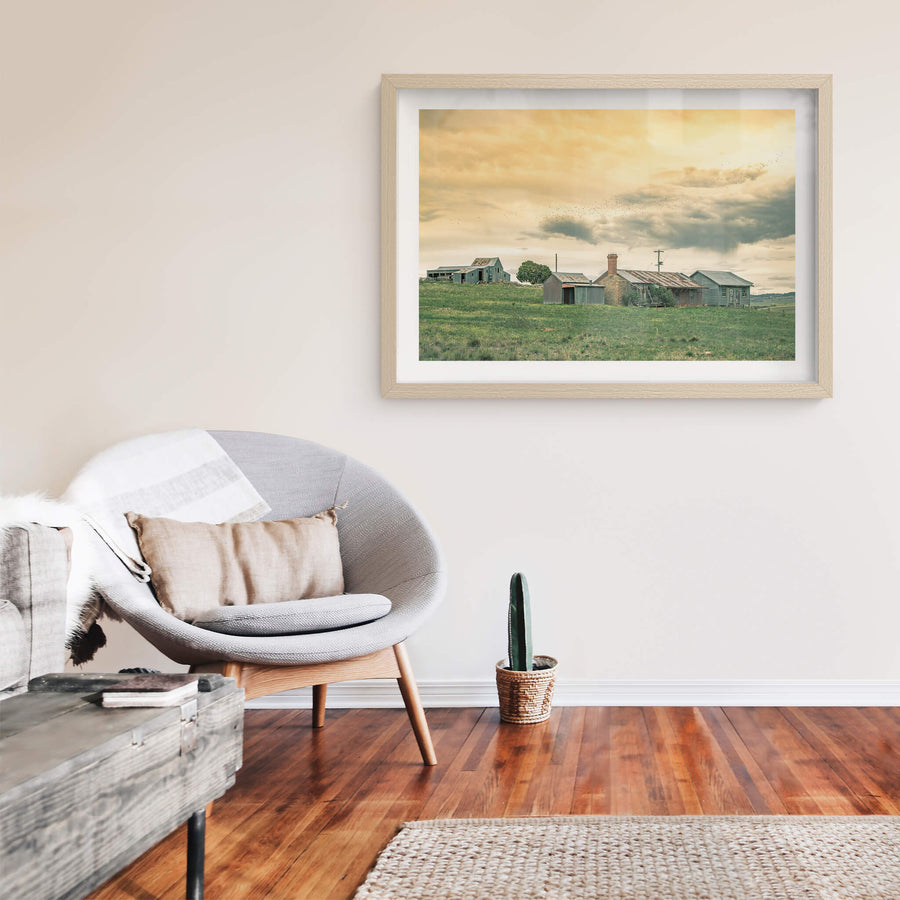
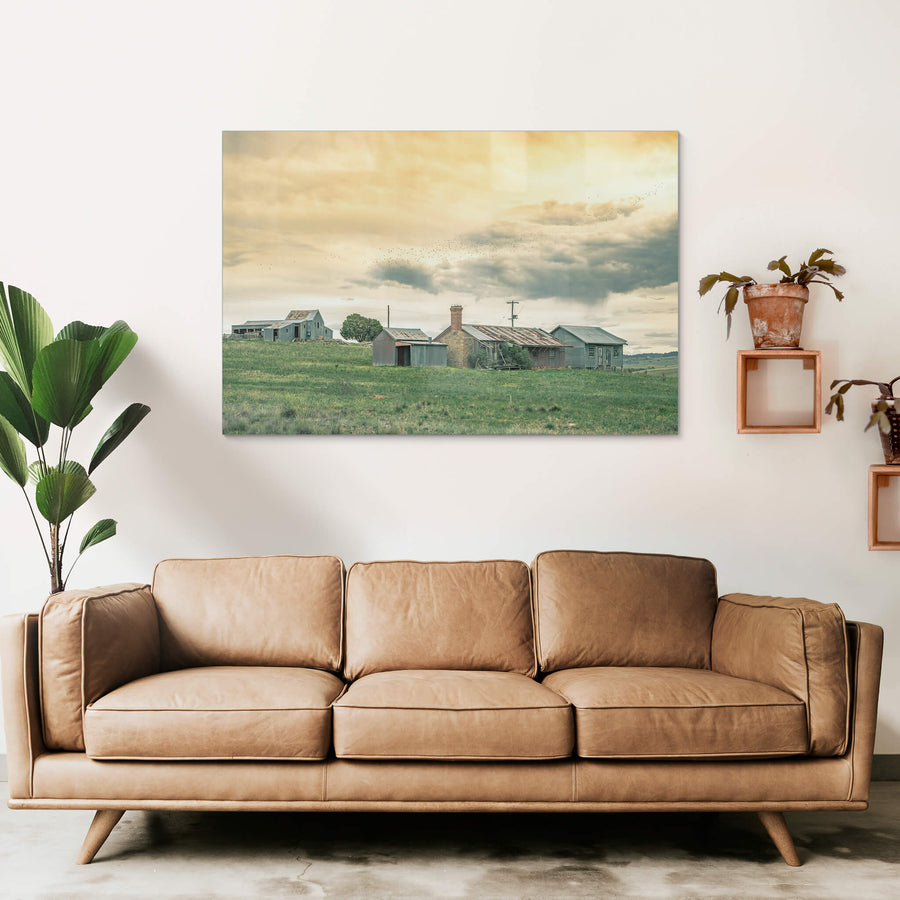
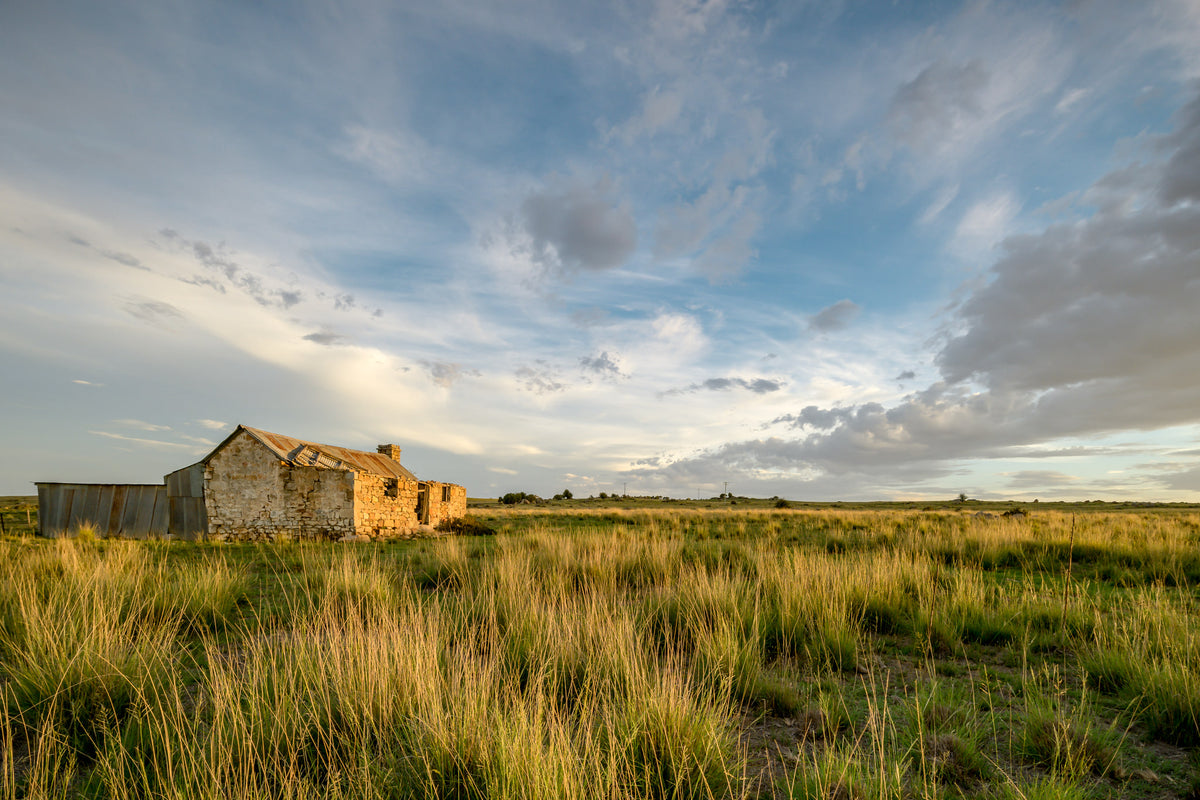
A low-slung building with a rusted corrugated iron roof stands in open pasture on the Snowy Monaro tableland, southern New South Wales, its weathered form set against a wide, cloud-heavy sky. Grass runs right to the building's edge. A secondary outbuilding stands beyond the main structure, and the flat plain reaches unbroken to the horizon.
Edition
Open edition
Open edition Printed to order, no fixed quantity. Each print is hand-signed by the photographer.
Limited edition A fixed number of prints exist. Once sold, the edition closes permanently. Each print is individually numbered and signed.
$100.00 AUD
Size
Type
Colour
✓
Signed, numbered, with COA. Made to order in 5 to 10 business days (unframed). Shipped in protective packaging with edition certificate, paper-stock reference and a printed care guide.
Numbla Vale is listed on the NSW State Heritage Inventory (Item ID 2410060). The timber cottages and the outbuilding beside them, photographed here in 2018, are the kind of structures that defined pastoral life across the Snowy Monaro: vernacular buildings put up by selectors and graziers using locally split timber, maintained through successive generations, and then left to the weather when the land or the economics or the family line gave out. The paint peeling from the cottage walls tells that story in layers. Each coat represents a period when someone was still there to apply it, still invested in the upkeep of the place. The outermost layers are the most recent, the thinnest, the most faded. Underneath, older colours show through where the timber has contracted and the paint has lifted. The outbuilding beside the cottages is further gone, its framing exposed, the corrugated iron on the roof working loose. Buildings like these sit in a particular gap in heritage protection. The alpine huts of Kosciuszko National Park are maintained by the Kosciuszko Huts Association and parks staff. Town buildings across the region appear in council Local Environmental Plan schedules, with the Cooma-Monaro LEP 2013 alone listing 230 heritage items. But isolated pastoral structures on private or Crown land, structures like these at Numbla Vale, often have no organised protection. The NSW State Heritage Inventory listing records their existence; it does not guarantee their survival. The Snowy Monaro's rural buildings represent the full arc of European settlement on Ngarigo country: squatter huts from the 1830s and 1840s, selector cottages built after the Robertson Land Acts of 1861, and consolidated pastoral infrastructure from the wool boom of the 1870s to the 1890s. Three subsequent waves, the 1890s drought and rabbit plague, the displacement caused by the Snowy Mountains Hydro-electric Scheme in the 1960s, and the collapse of the Wool Reserve Price Scheme in 1991, left more and more of these buildings standing empty. This photograph, made in 2018, is part of the A Place to Call Home series documenting what remains.
04·FROM THE FIELD NOTES
Timber cottages with faded, peeling paint stand beside a second outbuilding. Walls show multiple layers of paint and exposed weathered timber beneath.
Brett Patman
The series
A Place to Call Home
2015–2020 · 60
photographs
A series of rural homesteads from the Snowy Monaro region of southern New South Wales, with a few from the Hunter Valley. Most were family homes left behind when a generation moved to town; others when the land could no longer be worked. The buildings are smaller than the industrial sites that anchor most of Lost Collective and tend to be older. Most are timber-framed.
The anatomy view shows what this finish is as a physical object: paper margin, mat band, frame depth, acrylic profile. The comparison strip shows how each size sits relative to the others at true scale. Click a size or a finish to update both.