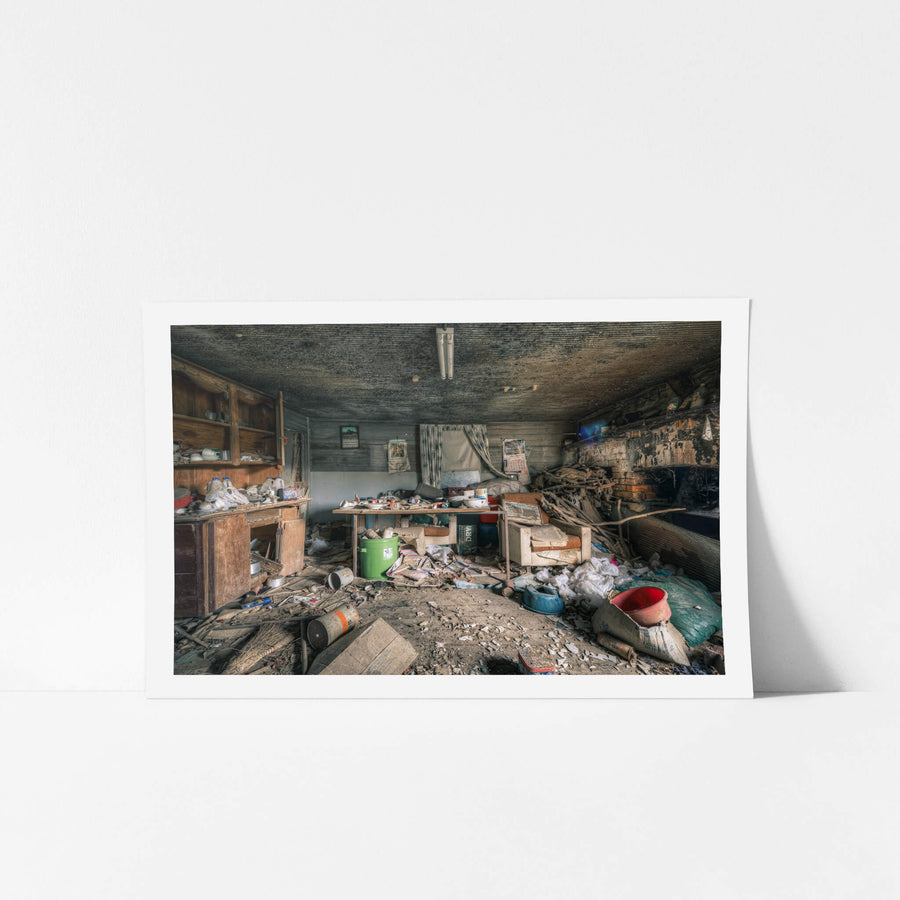
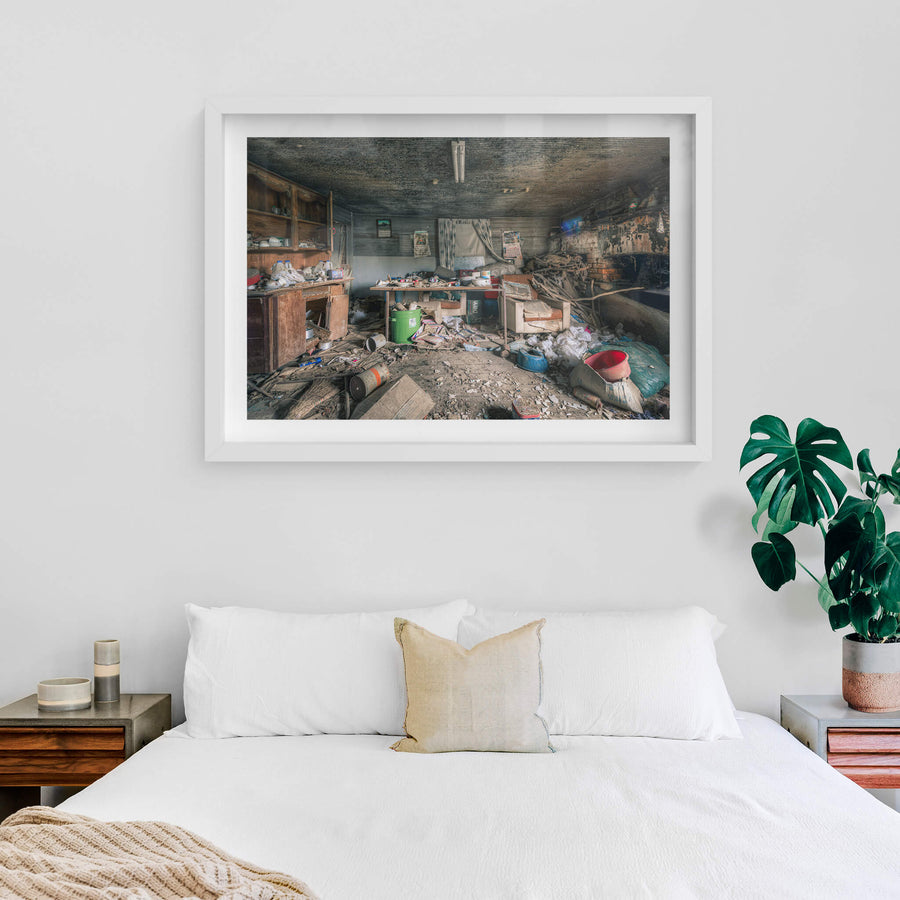
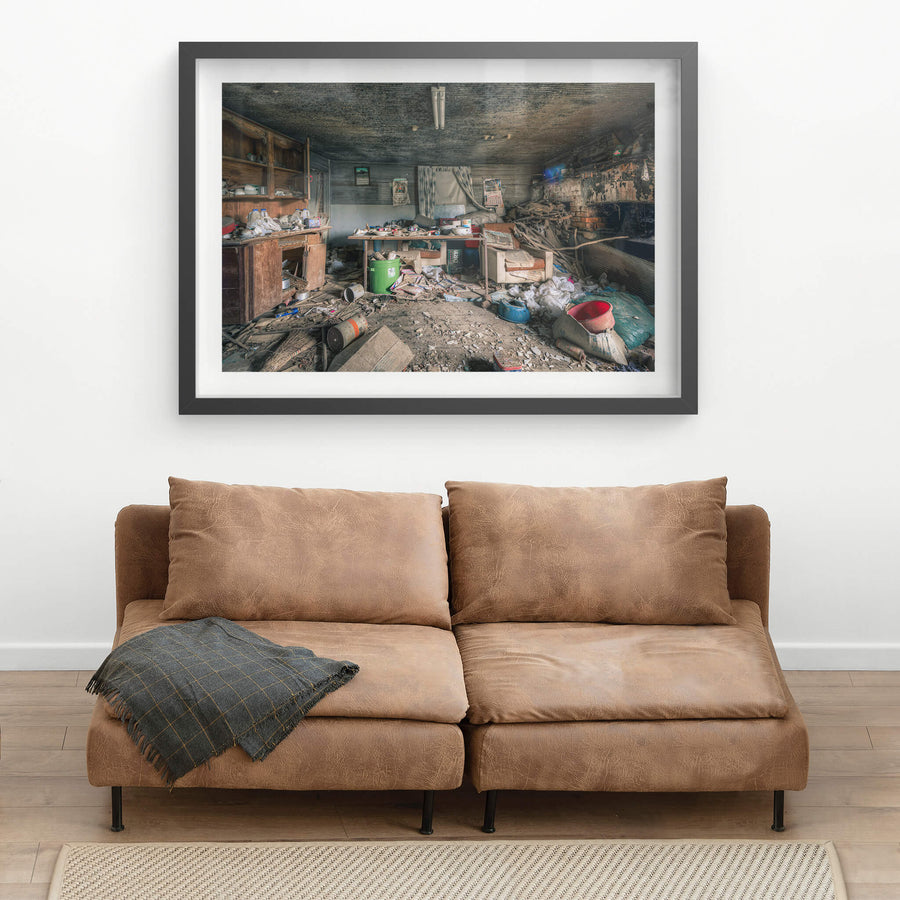
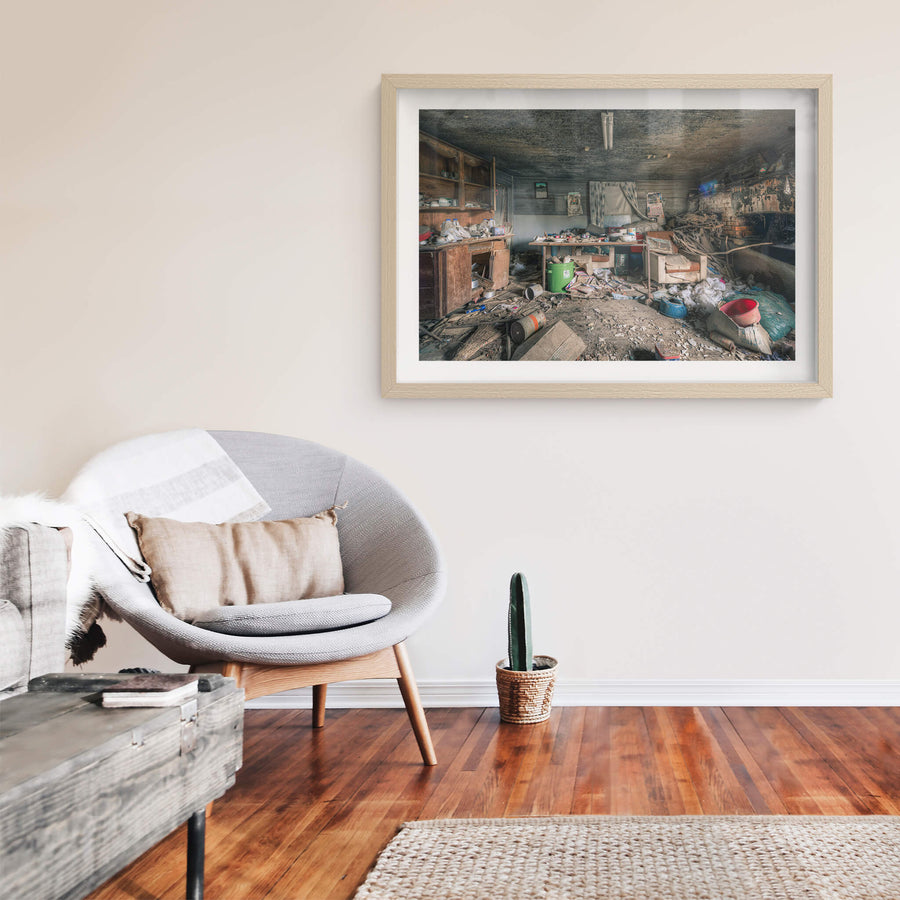
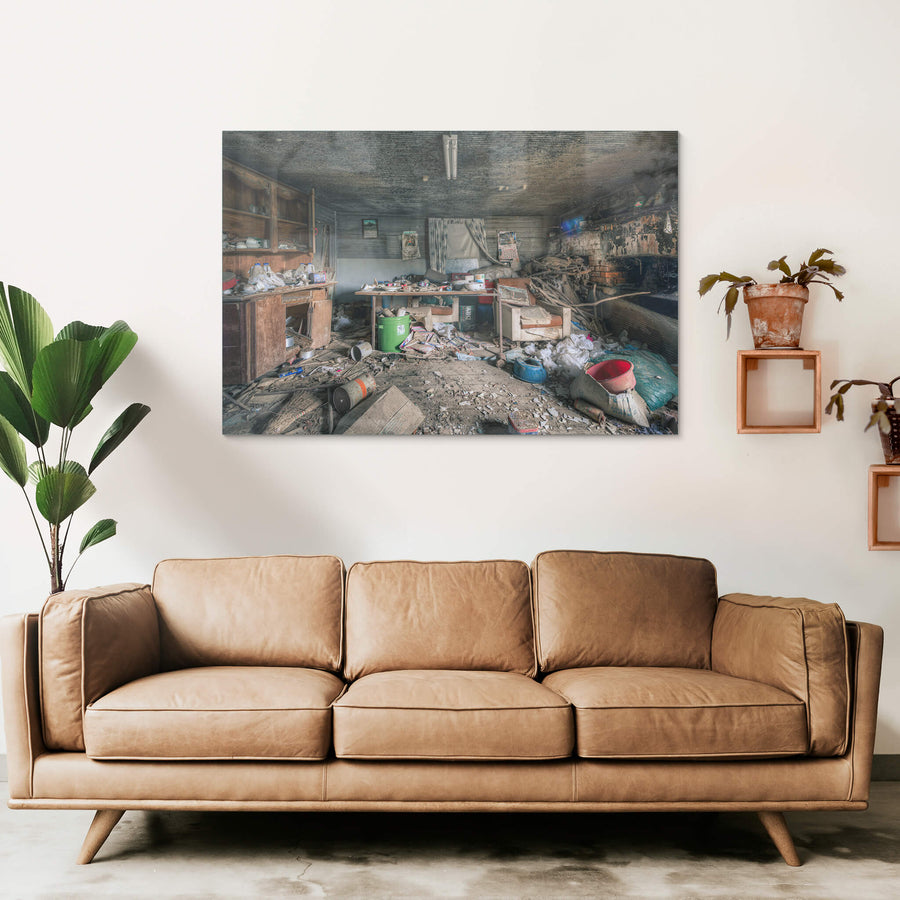
Corrugated iron ceiling, blackened with mould, over the dining area. Timber dresser along the left wall. Upturned buckets and a green drum on the floor. Scattered newspapers across the debris. Firewood and branches leaning against an exposed brick fireplace. Low ceiling height throughout the frame.
Edition
Open edition
Open edition Printed to order, no fixed quantity. Each print is hand-signed by the photographer.
Limited edition A fixed number of prints exist. Once sold, the edition closes permanently. Each print is individually numbered and signed.
$100.00 AUD
Size
Type
Colour
✓
Signed, numbered, with COA. Made to order in 5 to 10 business days (unframed). Shipped in protective packaging with edition certificate, paper-stock reference and a printed care guide.
The dining room of the Big Hill Post Office residence is framed by a corrugated iron ceiling, its surface blackened with mould. The ceiling sits low, pressing down over a room that has been coming apart for decades. A timber dresser still stands against the wall. On the floor around it: upturned buckets, a green drum, scattered newspapers, and firewood and branches leaning against an exposed brick fireplace. The building that housed this room opened on 1 November 1869, when the NSW Postmaster-General gazetted the Big Hill Post Office into existence. The gazette notice, signed by Daniel Egan on 7 October 1869, described it simply as "Big Hill, near Marulan." The post office operated for 76 years, closing in 1945. For most of that period, the arrangement was the one typical of rural NSW in the period: a family ran the post office out of their own home, with the public-facing kiosk at the front of the building and the rest of the structure given over to domestic life. The dining room, the fireplace, the dresser, these were the private side of that arrangement. Big Hill sits at 658 metres on the Southern Tablelands, in the Upper Lachlan Shire, north of Marulan. The settlement grew out of a grazing district established around Hannibal Hawkins Macarthur's Arthursleigh property from 1819. By the time the post office opened fifty years later, the village had a Methodist chapel and a school alongside it. By 1945, when the post office closed, farm amalgamations and better transport to larger towns had reduced the community enough that the service was no longer viable. What the 2020 photograph records is the room as it has been left: the dresser upright, the fireplace exposed with the firewood still stacked against it, the ceiling intact but advancing steadily toward the floor. The newspapers scattered across the ground echo the newspapers that once lined the walls of the bedrooms here as draught insulation against the sub-freezing winters at this elevation. Different newspapers, same building, same silence.
04·FROM THE FIELD NOTES
Corrugated iron ceiling, blackened with mould, over the dining area. Timber dresser along the left wall. Upturned buckets and a green drum on the floor.
Brett Patman
05·SIZE GUIDE
Printsizes.
The anatomy view shows what this finish is as a physical object: paper margin, mat band, frame depth, acrylic profile. The comparison strip shows how each size sits relative to the others at true scale. Click a size or a finish to update both.