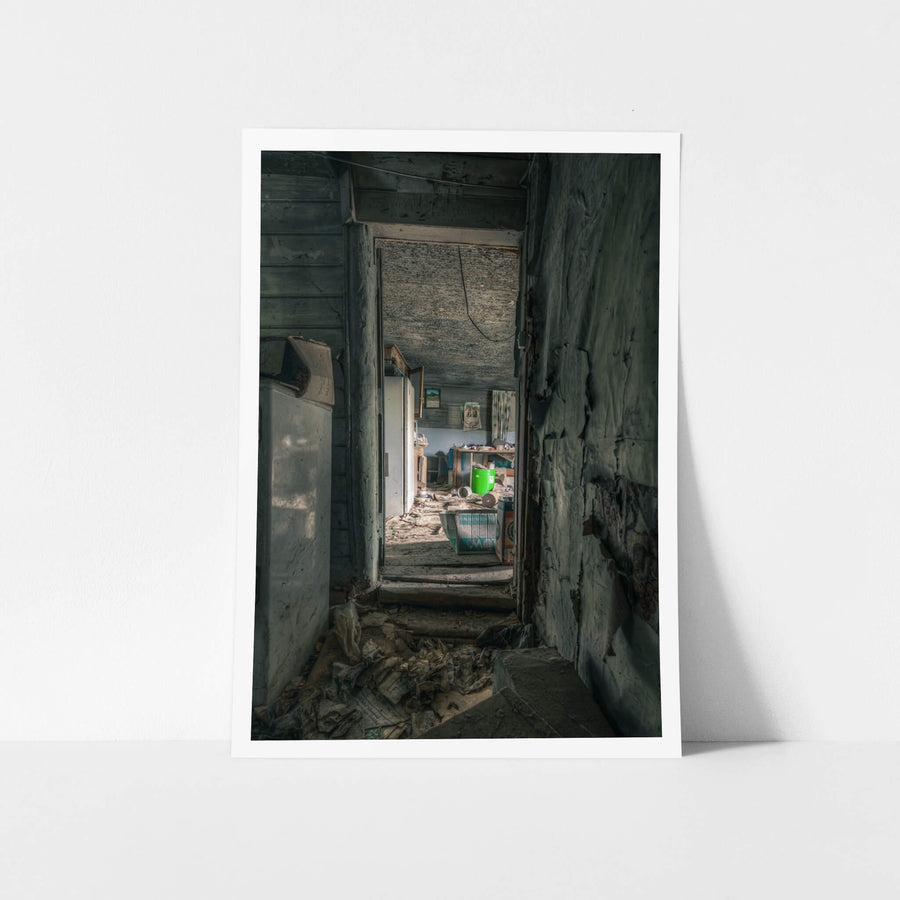
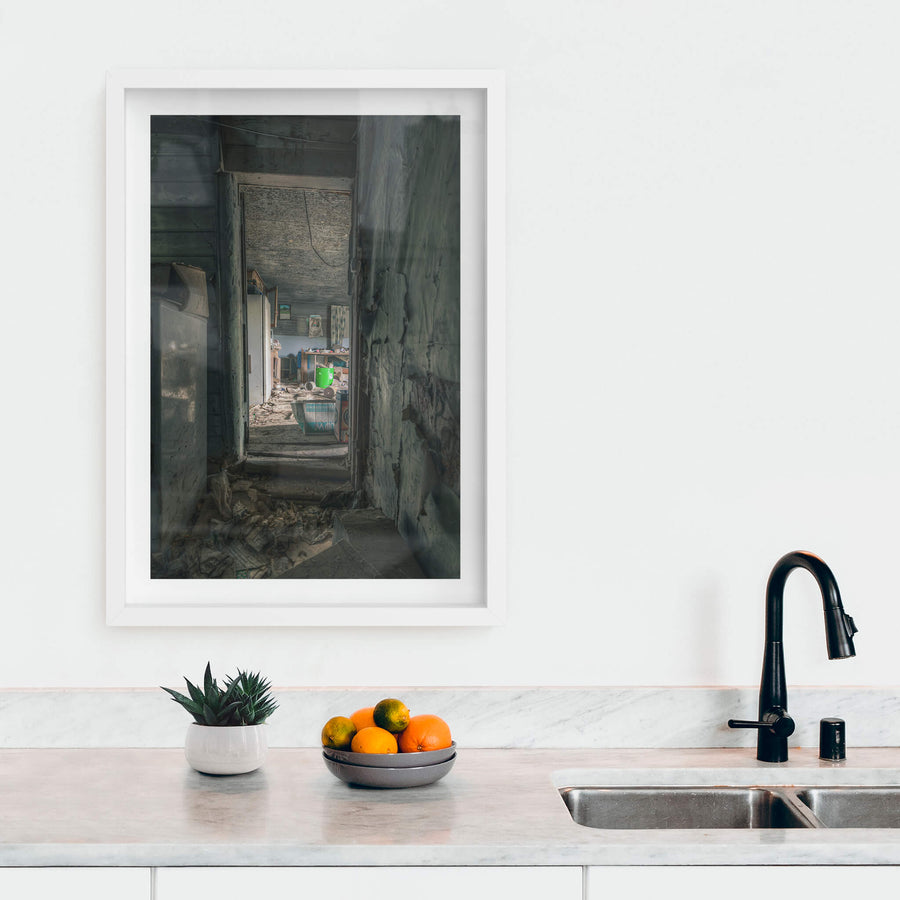
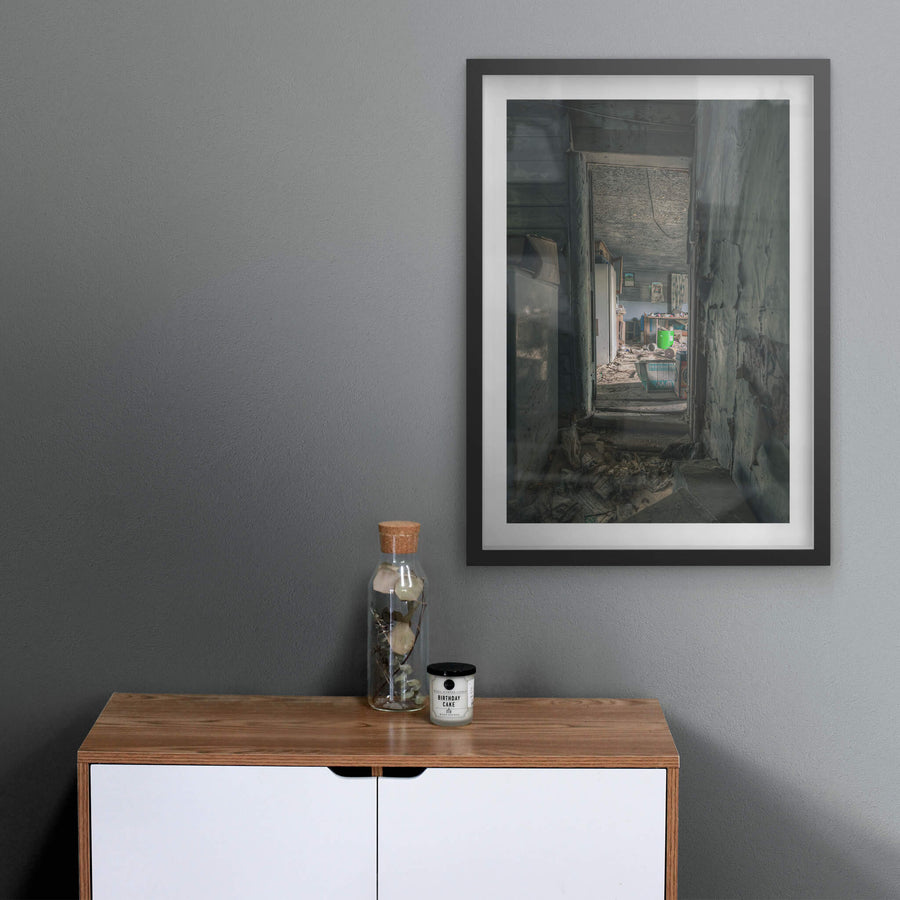
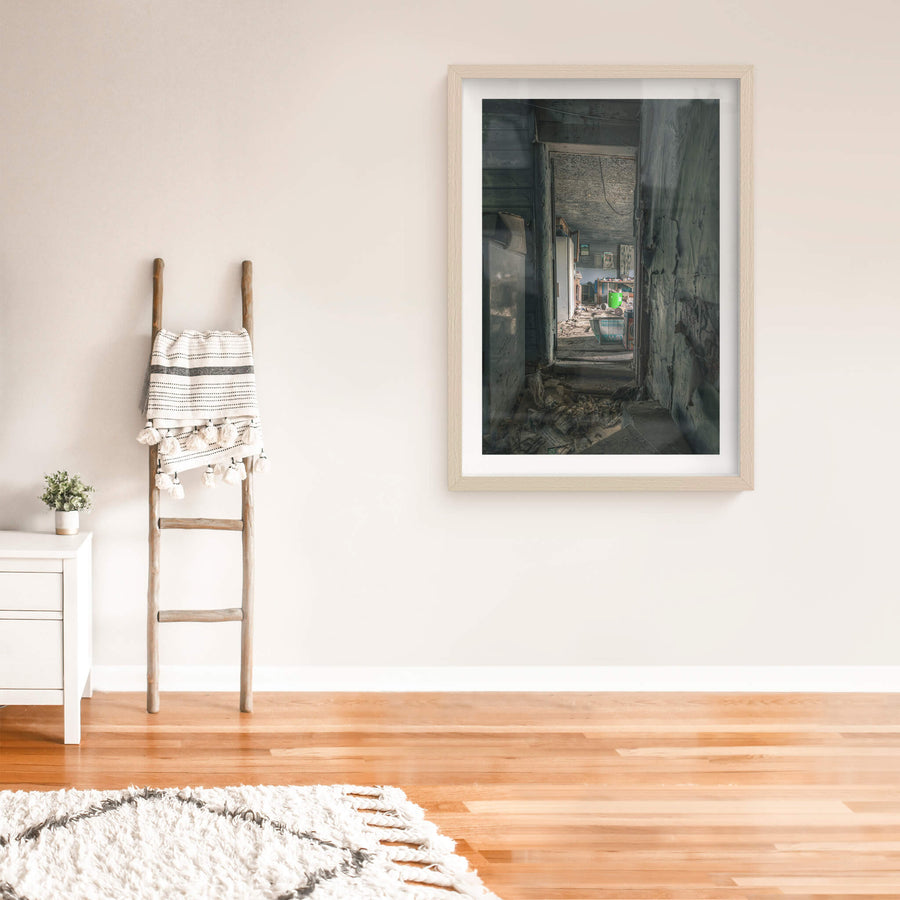
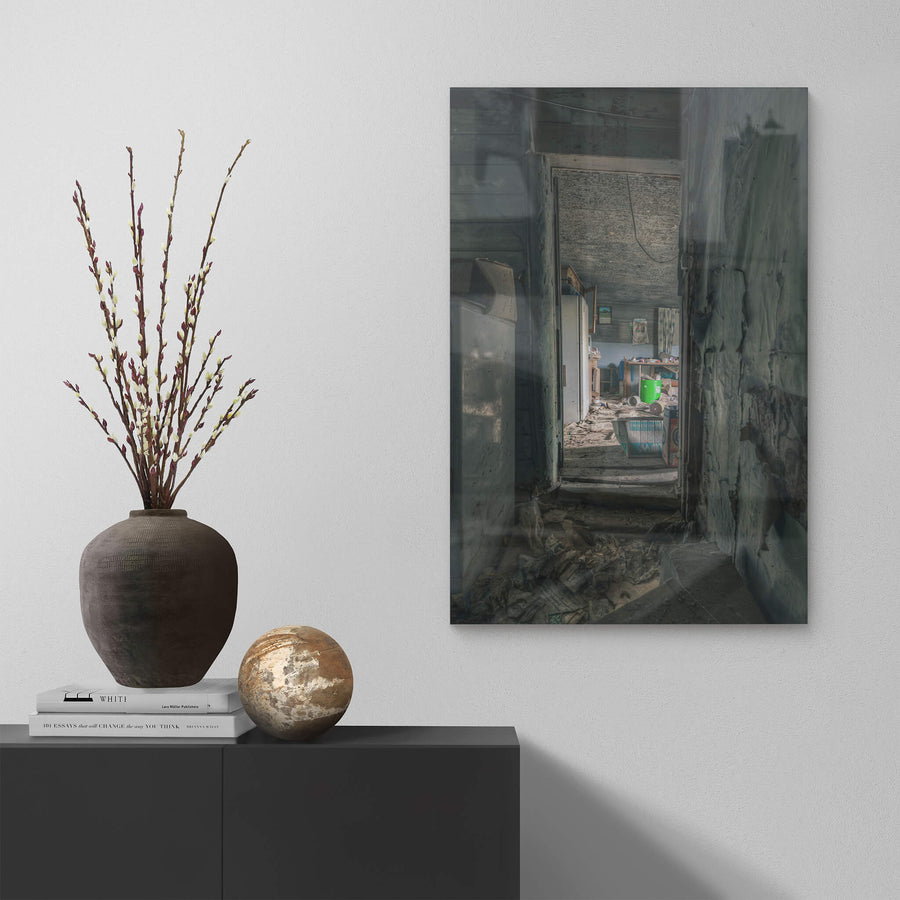
A hallway stretches toward a distant doorway. Paint has peeled from the walls in broad, irregular strips, leaving exposed surfaces below. Light enters from the far end of the corridor, catching suspended dust motes in the still air. Newspapers, a collapsed cardboard box and a green bucket lie across the debris-covered floorboards, with 2 white refrigerators standing in the room beyond.
Edition
Open edition
Open edition Printed to order, no fixed quantity. Each print is hand-signed by the photographer.
Limited edition A fixed number of prints exist. Once sold, the edition closes permanently. Each print is individually numbered and signed.
$100.00 AUD
Size
Type
Colour
✓
Signed, numbered, with COA. Made to order in 5 to 10 business days (unframed). Shipped in protective packaging with edition certificate, paper-stock reference and a printed care guide.
The hallway at Big Hill Post Office runs the length of the postmaster's residence, connecting the living area at one end to the kitchen and dining rooms at the other. Paint has lifted from the walls in broad, irregular strips, curling back to reveal the surface beneath. At the far end, a doorway opens to another room, and the light coming through it is the only light in the corridor, enough to catch the dust suspended in the still air. Newspapers, a collapsed cardboard box and a green bucket lie across the debris-covered floorboards, with 2 white refrigerators standing in the room beyond. Big Hill Post Office opened on 1 November 1869, its establishment gazetted by NSW Postmaster-General Daniel Egan in the Government Gazette of 8 October 1869. It served the small settlement at Big Hill, north of Marulan, on the Southern Tablelands of New South Wales, in what is now Upper Lachlan Shire. The arrangement was the standard rural pattern of the period: the post office function occupied a small kiosk at the front of the building, with a window and a mail slot facing the road. The rest of the building was a family home. Mail to and from the office was carried by contractor John Wade, who was awarded a three-year contract in November 1869 to run the route between Mooroowoolen, Long Reach, and Big Hill three times a week by horseback, at £45 per annum. The settlement had been built on land first granted to pastoralist Hannibal Hawkins Macarthur in 1819, fifty years before the post office opened. By the time the post office was established, Big Hill had grown into a small but functioning community: a Methodist chapel, a school, and the post office itself. The building's internal walls were plastered with newspaper as insulation against the sub-freezing winters typical at 658 metres elevation. Multiple bedrooms, each with its own fireplace, lined the residence. The post office closed in 1945, after 76 years of operation. Brett Patman photographed the abandoned building in 2020. This photograph records the hallway as it stood that day: peeling walls, a doorway letting in thin light, and dust that had been settling, undisturbed, for a long time.
04·FROM THE FIELD NOTES
The hallway at Big Hill Post Office connected the living quarters of the postmaster's residence to the kitchen and dining area at the rear. Paint peels from the walls in broad strips; a doorway at the far end lets in the only light, catching dust in the still air. The building operated as both post office and postmaster's home for 76 years, from 1 November 1869 until 1945, serving the grazing district north of Marulan on the Southern Tablelands of New South Wales. By 2020, the residence stood abandoned, its hallway emptied of everything but peeling walls and drifting dust.
Brett Patman
05·SIZE GUIDE
Printsizes.
The anatomy view shows what this finish is as a physical object: paper margin, mat band, frame depth, acrylic profile. The comparison strip shows how each size sits relative to the others at true scale. Click a size or a finish to update both.