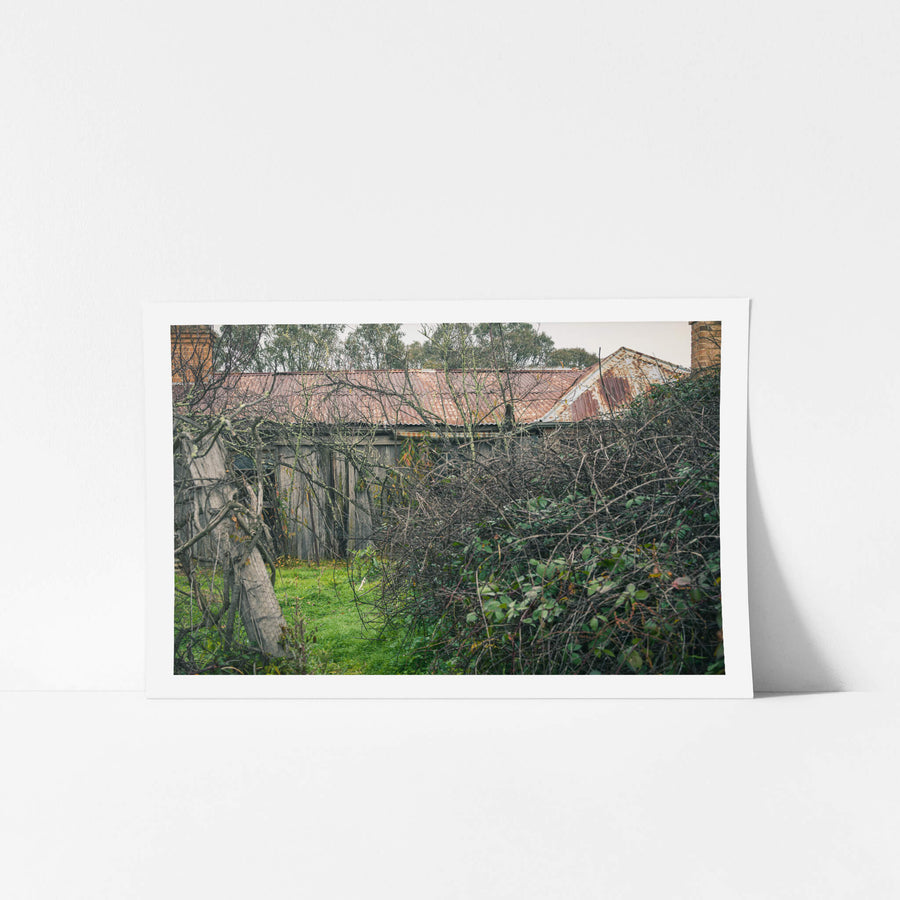
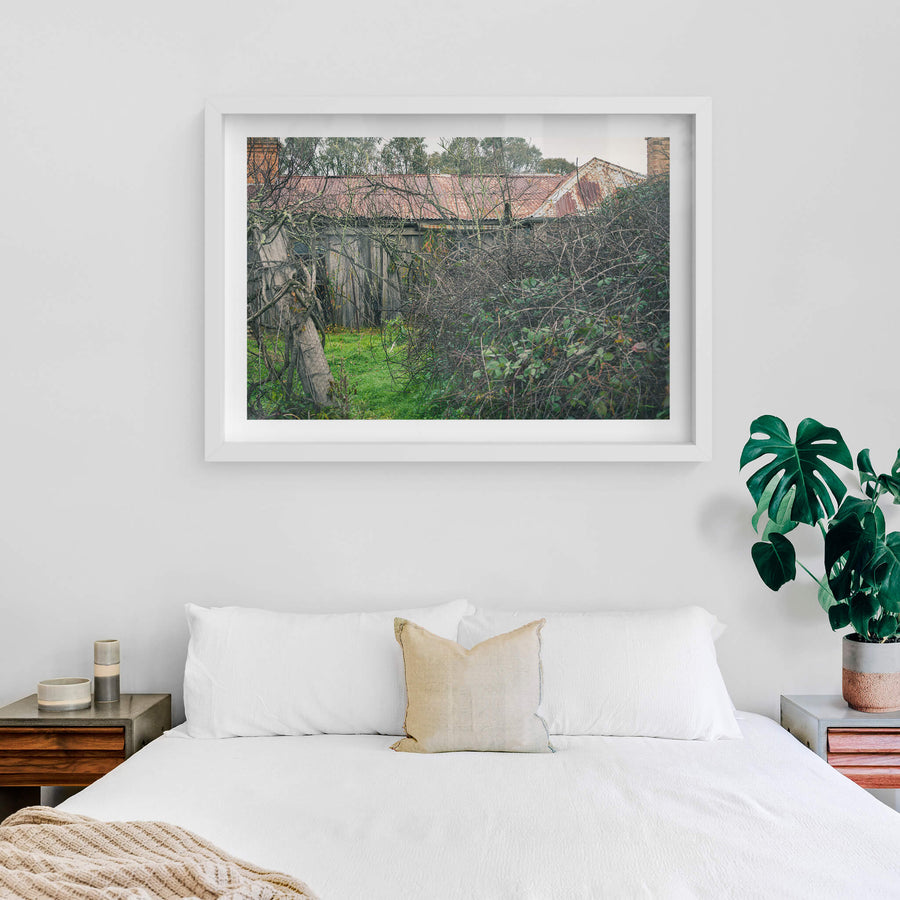
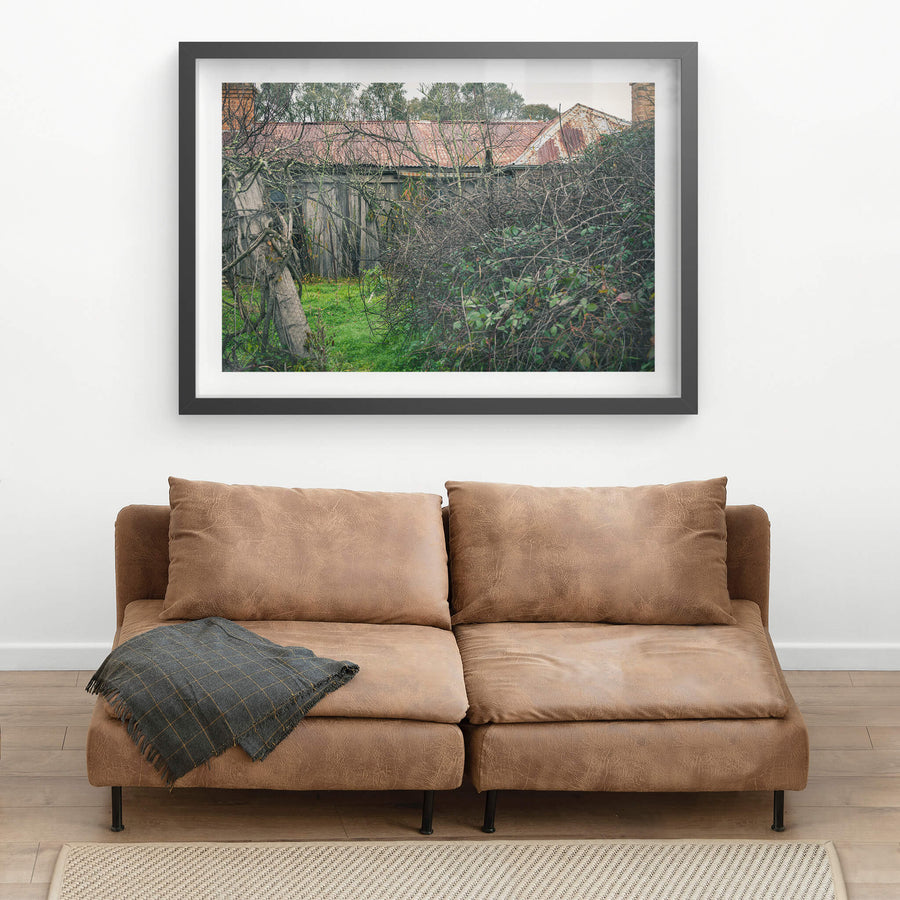
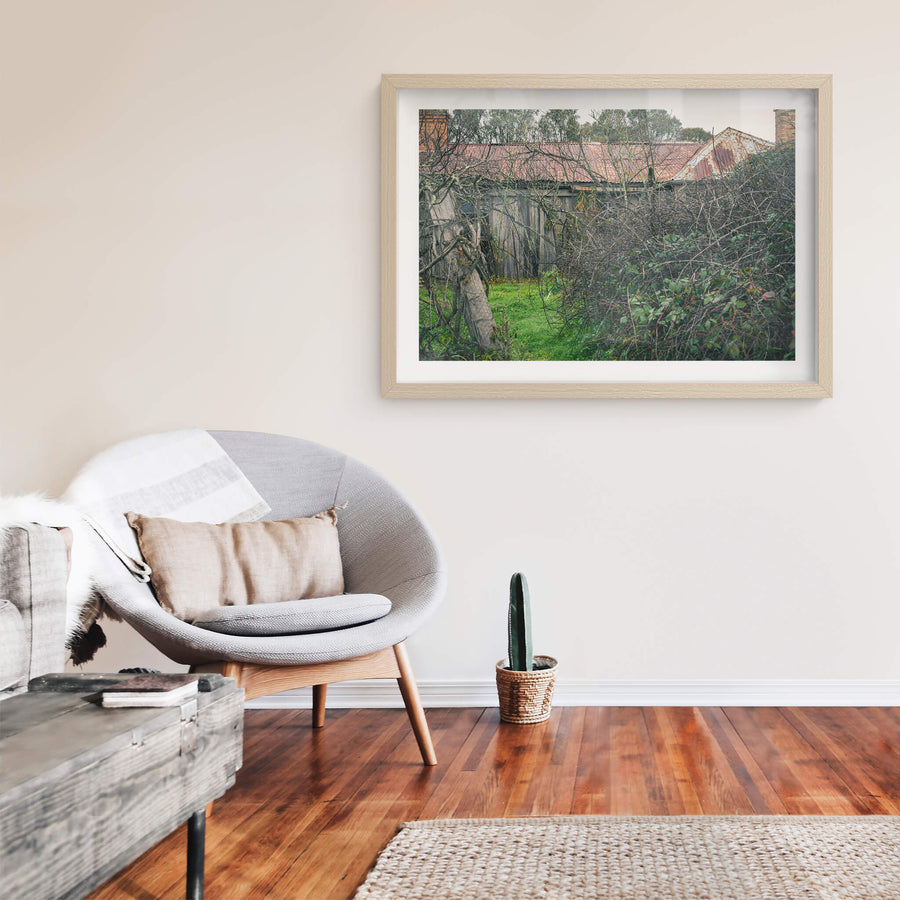
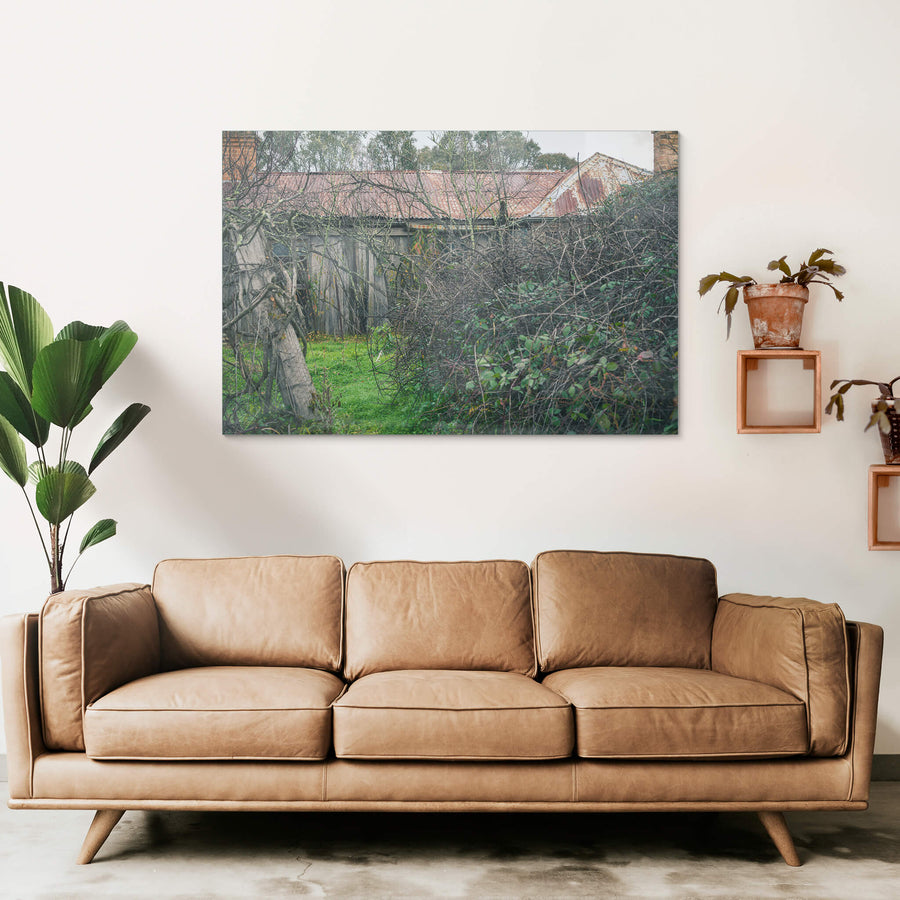
Blackberry canes press across the back gate at Big Hill Post Office in dense, thorny tangles, reducing the weatherboard wall and rusted iron roof to fragments visible between the stems. A pale, gnarled trunk crowds the left of the frame, its lichen-patched branches pushing against a small window opening. The overgrowth has reached a point where the building reads as interruption rather than subject.
Edition
Open edition
Open edition Printed to order, no fixed quantity. Each print is hand-signed by the photographer.
Limited edition A fixed number of prints exist. Once sold, the edition closes permanently. Each print is individually numbered and signed.
$100.00 AUD
Size
Type
Colour
✓
Signed, numbered, with COA. Made to order in 5 to 10 business days (unframed). Shipped in protective packaging with edition certificate, paper-stock reference and a printed care guide.
The photograph shows the facade of the Big Hill Post Office almost entirely consumed by vines and dense foliage. Light comes through the canopy in filtered patches. The timber structure is still there, vertical and horizontal framing elements visible where the growth breaks, but the building is no longer in control of what sits on its surface. Blackberry and creeping vine have been at work long enough to reach the roofline. The Big Hill Post Office opened on 1 November 1869, gazetted by NSW Postmaster-General Daniel Egan just weeks earlier in the Government Gazette of 8 October 1869. The settlement it served sat on land first granted to pastoralist Hannibal Hawkins Macarthur in September 1819, by the time the post office opened, fifty years of continuous grazing had built a small village around a Methodist chapel, a school, and the post office itself. The building functioned both as the local mail point and as the postmaster's residence, the typical rural arrangement of the period. The public face of the entire postal operation was a single kiosk window and a mail slot on the front of the building. The rest was a family home. Mail reached Big Hill by contractor. John Wade was awarded the first mail run on 29 November 1869, riding horseback three times a week through Mooroowoolen, Long Reach, and Big Hill on a three-year contract worth £45 per annum, effective 1 January 1870. The post office ran for 76 years, closing in 1945. The settlement contracted through that period as farm amalgamations reduced the local population and improved transport connected remaining residents to larger nearby towns. Big Hill Post Office stood on the Southern Tablelands, north of Marulan, at an elevation of 658 metres, winters cold enough that interior walls were plastered with newspaper for draught insulation. Brett Patman photographed the building in 2020. The overgrowth visible in this frame matched Brett's own caption notes for the back garden, dense blackberry consuming what had been the yard. The facade seen here tells the same story from the front.
04·FROM THE FIELD NOTES
By 2020, the exterior of the Big Hill Post Office had largely disappeared beneath dense vines and blackberry. The building on the Southern Tablelands of New South Wales opened as a post office and postmaster's residence on 1 November 1869, serving the small settlement of Big Hill, north of Marulan, for 76 years before closing in 1945. What the photograph records is not ruin so much as reclamation, the original timber frame still holding its shape beneath a canopy that shows no interest in giving it back.
Brett Patman
05·SIZE GUIDE
Printsizes.
The anatomy view shows what this finish is as a physical object: paper margin, mat band, frame depth, acrylic profile. The comparison strip shows how each size sits relative to the others at true scale. Click a size or a finish to update both.