
Engine Room
Provenance
- Camera
- NIKON D7000
- Lens
- 14.0-24.0 mm f/2.8
- Settings
- 14mm · f/8.0 · 1/6 · ISO 100
- Paper
- Ilford Galerie Smooth Cotton Rag 310 gsm
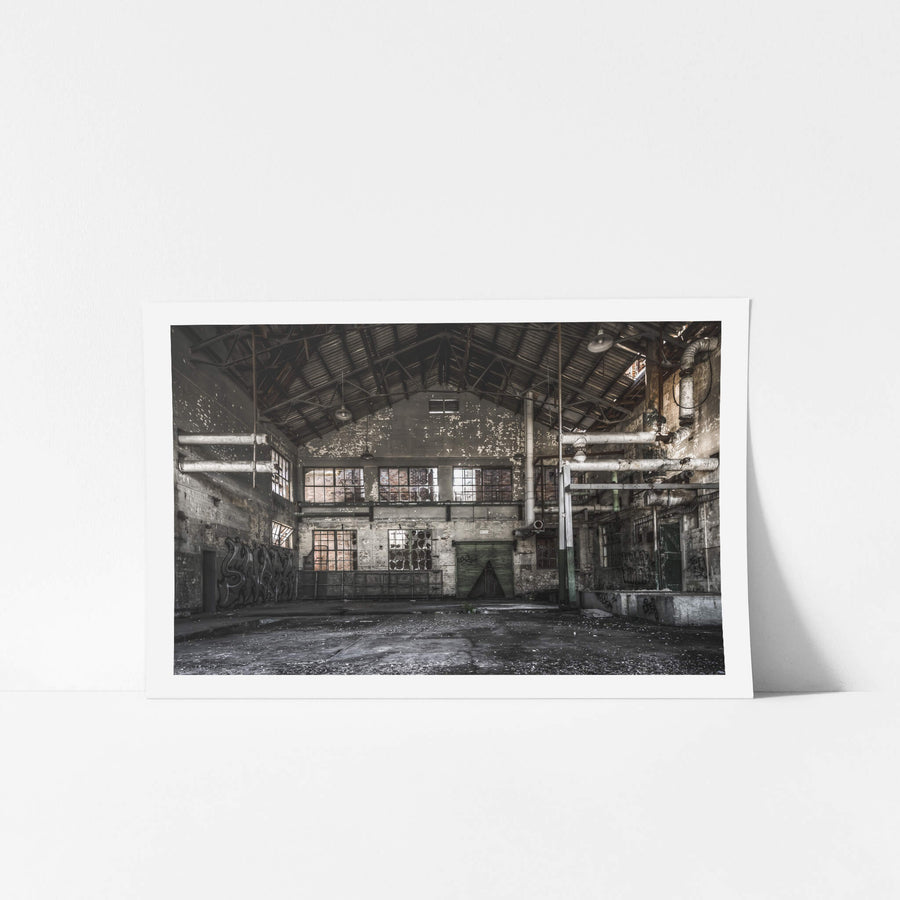
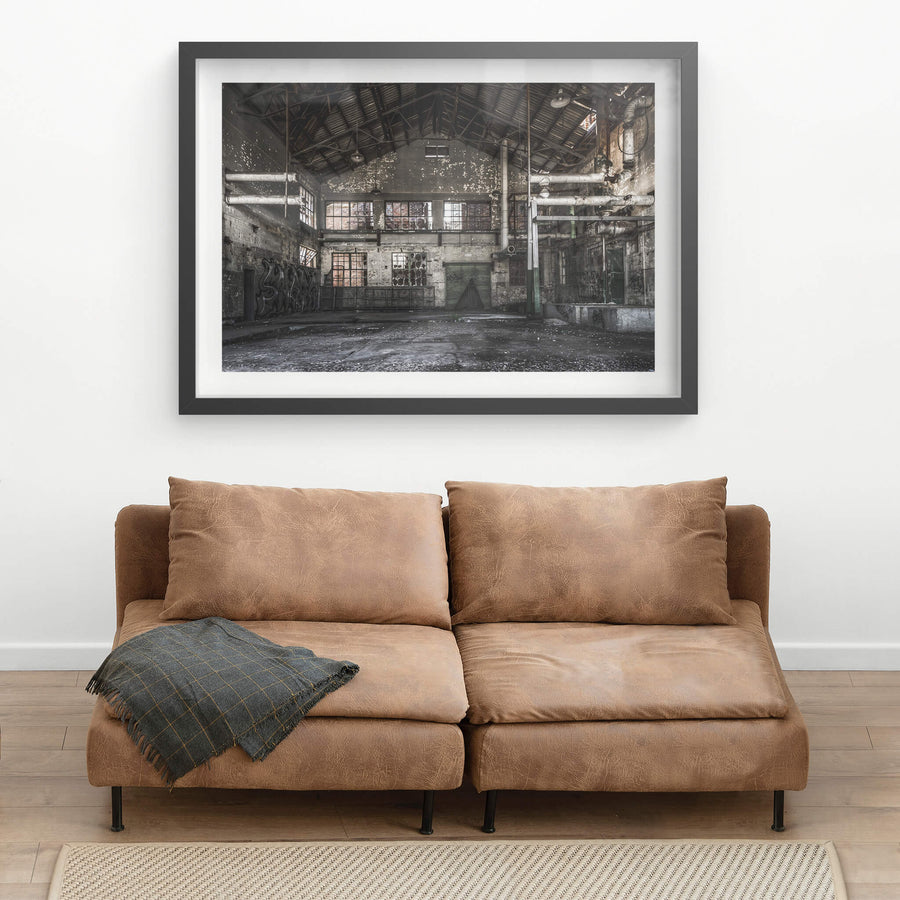
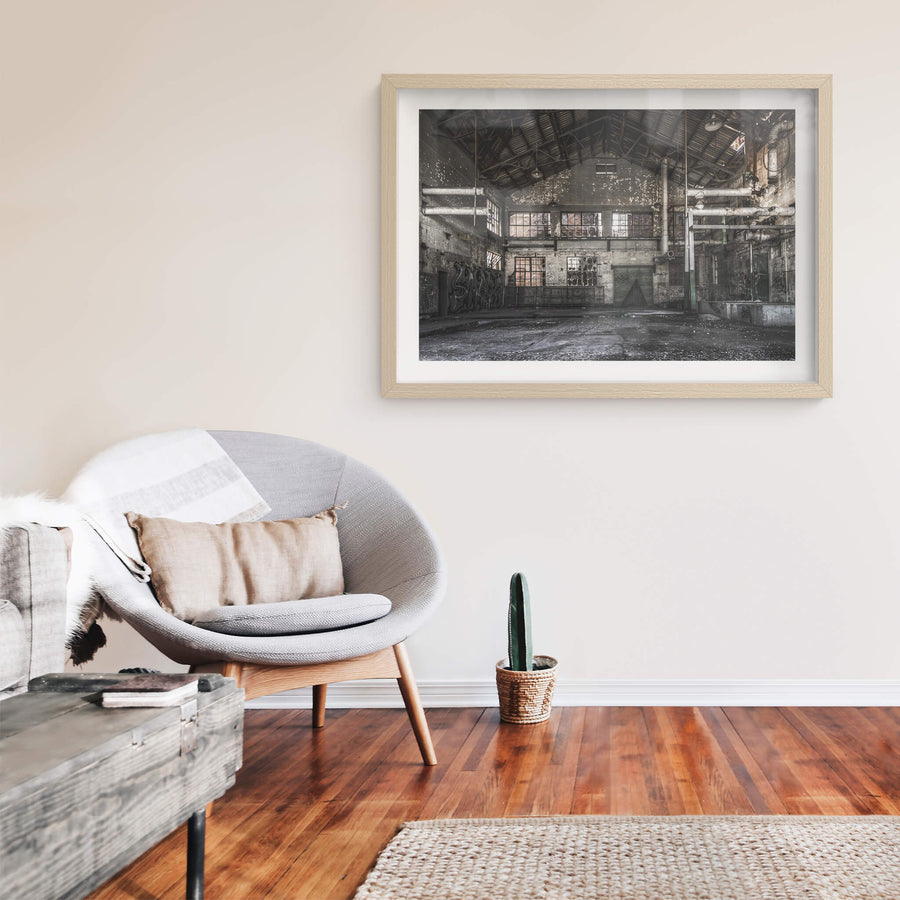
The engine room of the former Peters Creameries factory at Chatham, a bare industrial hall with dark graffiti sweeping across the lower left wall. Two large horizontal pipes extend from the brickwork toward the centre of the concrete floor. A green roller door with a triangular gap at its base sits on the far wall, flanked by overhead pipework and a vertical column, and broken windows on both levels let pale light fall across peeling paint and rusted surfaces.
Open edition
Printed to order, no fixed quantity. Each print is hand-signed by the photographer.
Limited edition
A fixed number of prints exist. Once sold, the edition closes permanently. Each print is individually numbered and signed.
Shipping Free shipping over $250. Ships worldwide, rates calculated at checkout.
Returns Damaged in transit? We replace it. Full policy →
Ships within 10 business days · signed & numbered
In situ


Print datasheet
- Title
- Engine Room
- Series
- Peters Ice Cream Factory
- Catalogue
- PIC-009
- Process
- Giclée
- Captured
- 14 February 2016
- Camera
- NIKON D7000
- Lens
- 14.0-24.0 mm f/2.8
- Aperture
- f/8.0
- Shutter
- 1/6 s
- ISO
- 100
- Focal length
- 14 mm
- Paper
- Ilford Galerie Smooth Cotton Rag 310 gsm
- Paper size
- 297 × 210 mm
- Location
- Taree, New South Wales, Australia
- Authenticity
- C2PA verified provenance →
- Recognised by
- Highly Commended in Multimedia at the 2016 National Trust of Australia (NSW) Heritage Awards
Taree, New South Wales, Australia
Map · Mapbox · OpenStreetMap
About this print
The engine room of Peters Creameries Pty Ltd's factory at Chatham, NSW, was the mechanical heart of a steam-driven dairy plant that opened in November 1939 before a crowd of approximately 5,000 people. Machinery supplied by Richard Wildridge and Co. of Sydney drove operations that processed 1,000 gallons of milk per hour. By the time this photograph was made in 2016, rust had traced patterns across the pipes and gears, and dust had settled over every surface. The factory operated from 1939 until the late 1990s, when corporate rationalisation under successive owners ended production at Chatham.
Brett Patman

The series
Peters Ice Cream Factory
Peters Ice Cream Factory opened on 4 November 1939 on the bank of the Manning River at Chatham, a suburb of Taree. The opening drew approximately 5,000 people. Peters Creameries built the plant for around £60,000, with a steam-driven capacity of 1,000 gallons of milk per hour and a boiler house running four Babcock and Wilcox boilers. Cream was delivered by boat from farms along the Manning River for four decades, a trade that ran until around the 1970s. The factory made ice cream, butter, milk powder, oil, and yoghurt, and was the main employer in the Manning Valley until it closed in the late 1990s. The building still stands at Chatham, deteriorating. Listed in 1990 on the local heritage register (Greater Taree, now MidCoast Council).
Print sizes
The anatomy view shows what this finish is as a physical object: paper margin, mat band, frame depth, acrylic profile. The comparison strip shows how each size sits relative to the others at true scale. Click a size or a finish to update both.
| Type | Size | Width | Height |
|---|


