
Exit
Provenance
- Camera
- NIKON D850
- Lens
- 14.0-24.0 mm f/2.8
- Settings
- 14mm · f/8.0 · 6s · ISO 500
- Paper
- Ilford Galerie Smooth Cotton Rag 310 gsm
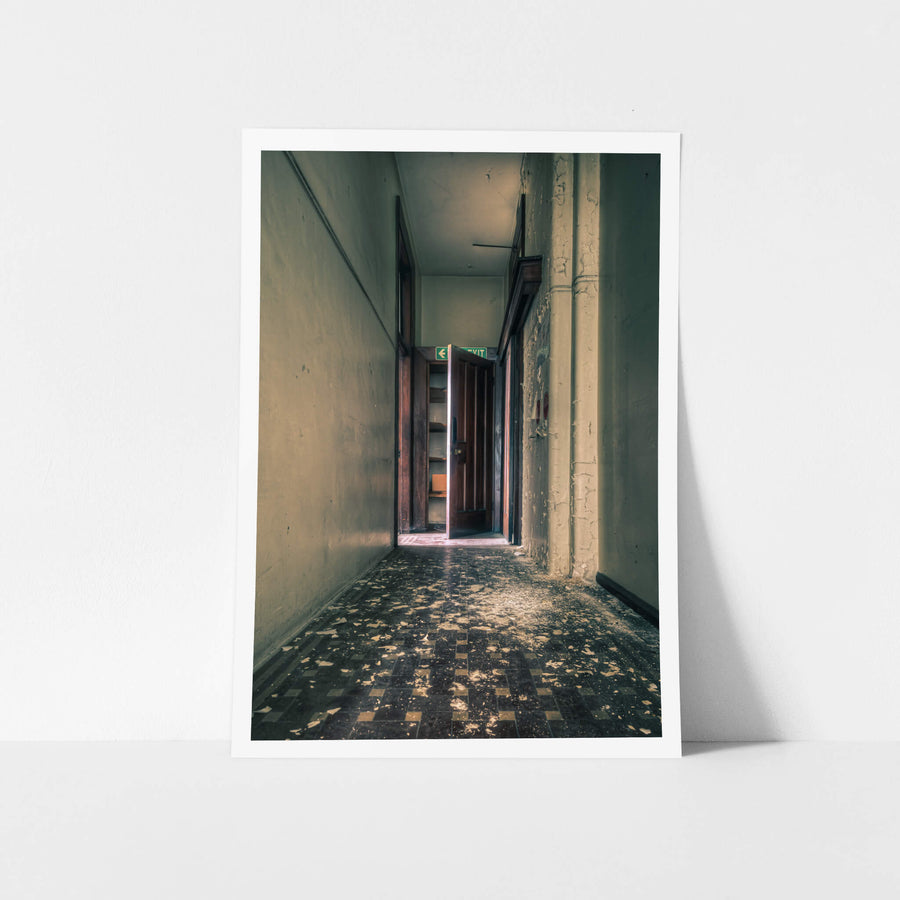
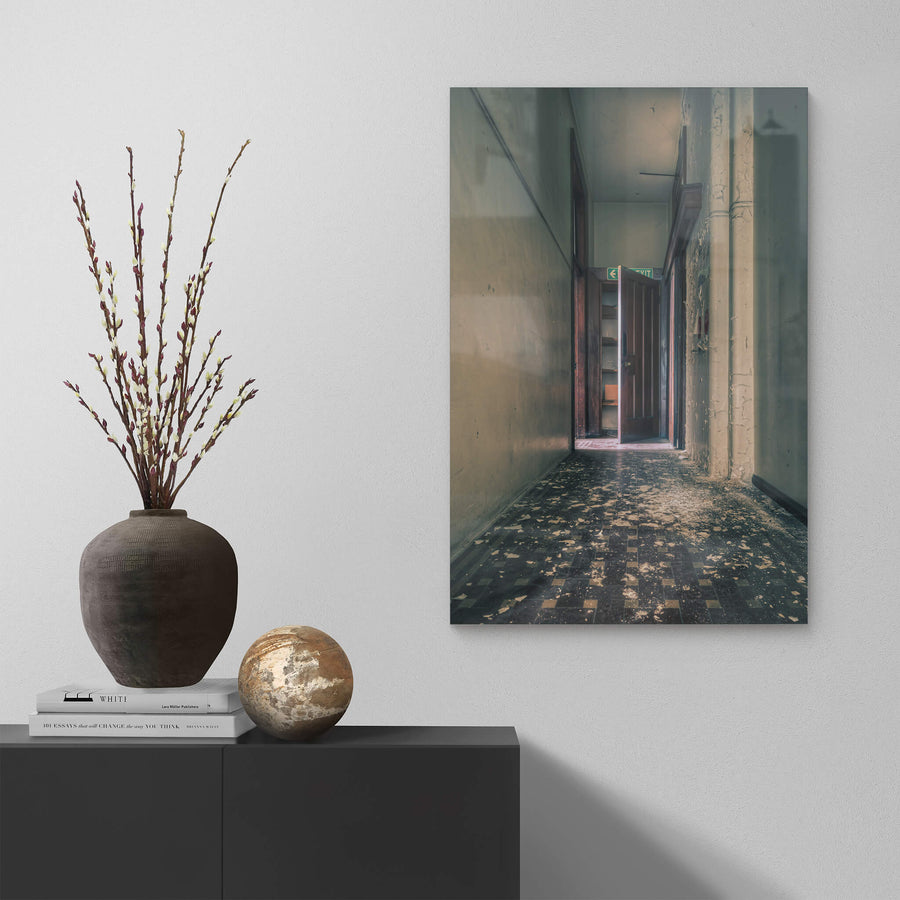
Light cuts across broken tiles and scattered debris midway down a long corridor, throwing the far wall into sharp relief. An open wooden door at the end frames a room lost in shadow, a green exit sign above it pointing left. Paint has pulled away from the right wall in broad irregular patches, bare plaster exposed along the full run of the passage. Photographed in the former Lewisham Hospital in 2019.
Open edition
Printed to order, no fixed quantity. Each print is hand-signed by the photographer.
Limited edition
A fixed number of prints exist. Once sold, the edition closes permanently. Each print is individually numbered and signed.
Shipping Free shipping over $250. Ships worldwide, rates calculated at checkout.
Returns Damaged in transit? We replace it. Full policy →
Ships within 10 business days · signed & numbered
In situ
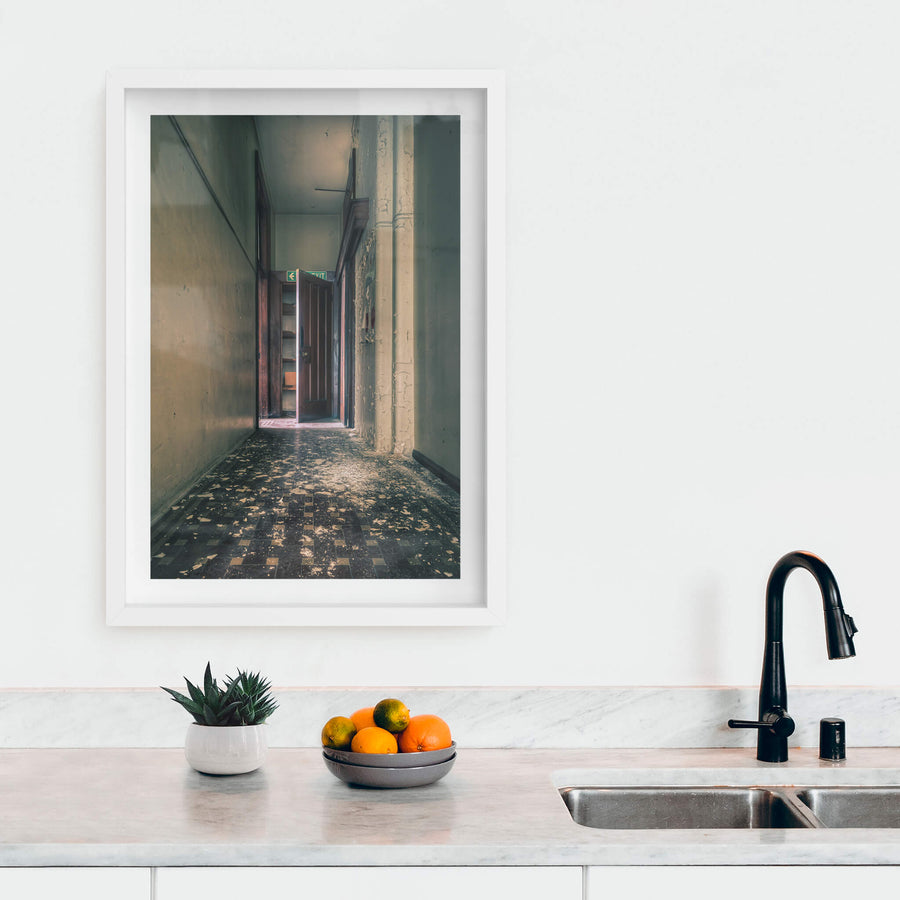
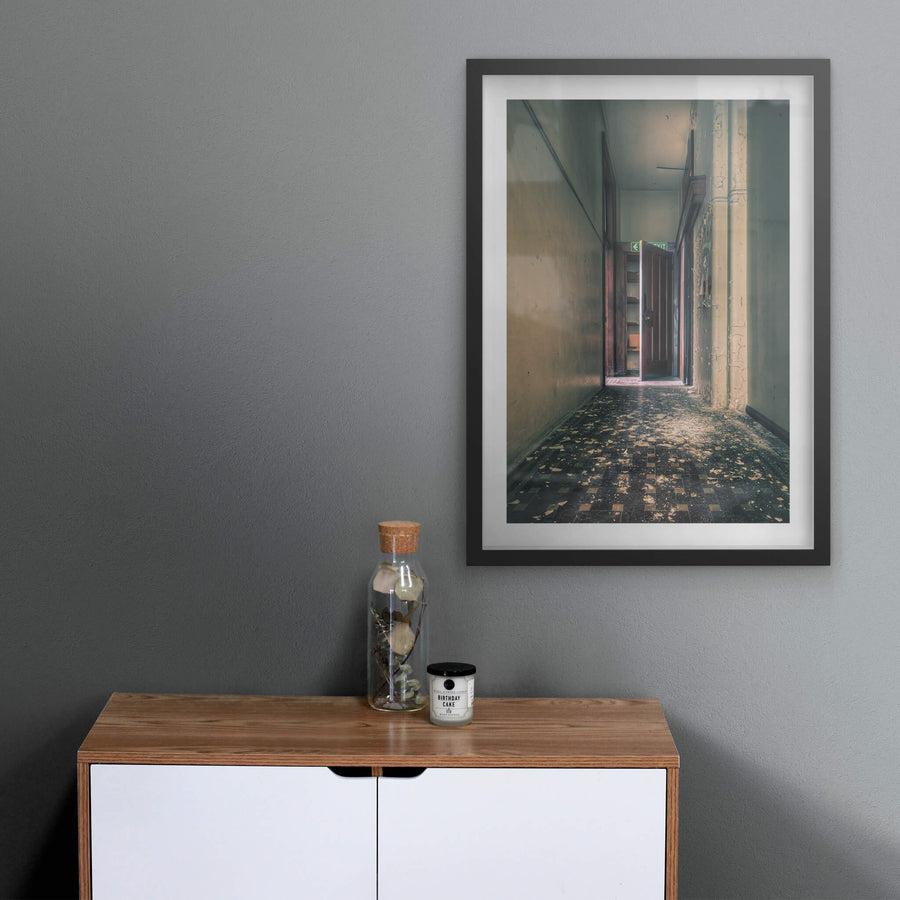
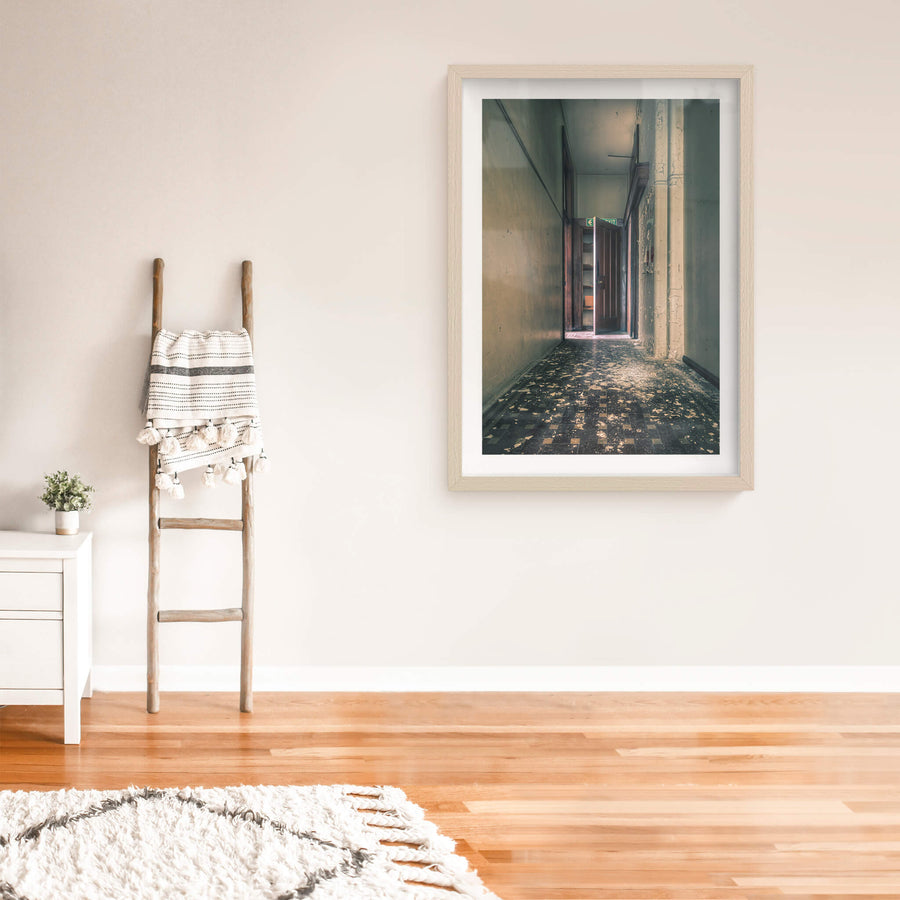
Print datasheet
- Title
- Exit
- Series
- Lewisham Hospital
- Catalogue
- LHO-010
- Process
- Giclée
- Captured
- 28 January 2019
- Camera
- NIKON D850
- Lens
- 14.0-24.0 mm f/2.8
- Aperture
- f/8.0
- Shutter
- 6s s
- ISO
- 500
- Focal length
- 14 mm
- Paper
- Ilford Galerie Smooth Cotton Rag 310 gsm
- Paper size
- 297 × 210 mm
- Location
- Lewisham, New South Wales, Australia
- Authenticity
- C2PA verified provenance →
- Recognised by
- Highly Commended in Multimedia at the 2016 National Trust of Australia (NSW) Heritage Awards
Lewisham, New South Wales, Australia
Map · Mapbox · OpenStreetMap
About this print
At the end of a corridor in the former Lewisham Hospital, Convent and Grounds, a doorway opens onto daylight. Paint has lifted from the frame in long strips, exposing the layers beneath. The Little Company of Mary ran this complex from 1889, when Cardinal Moran opened the first wing on West Street, until 1986. The novitiate building, where women entered the order and trained as nurses, was the origin point for an institution that eventually expanded across Australia and into four continents. By the time the sisters left, nearly a million outpatients had passed through the hospital's doors.
Brett Patman

The series
Lewisham Hospital
Lewisham Hospital was opened on 9 June 1889 by Cardinal Patrick Francis Moran, on the site where the Little Company of Mary, the Blue Nuns, had established their Sydney convent in 1887. Originally named the Children's Hospital of the Holy Child, it admitted women and children only until male patients were accepted from 1912. Over the following decades it became one of Sydney's main general hospitals and nurse training schools. It closed in 1988, a century of Catholic healthcare on one block of West Street, Lewisham. The Lost Collective photographs are of the novitiate building, the wing where new entrants to the order were trained, which sits within the broader hospital, convent, and grounds complex. The historic complex is listed as a local heritage item under the Inner West LEP (formerly Marrickville LEP 2011), within the Lewisham North Precinct. The convent chapel, in a revival Byzantine style with a 1927 Möller pipe organ, still stands on the site.
Print sizes
The anatomy view shows what this finish is as a physical object: paper margin, mat band, frame depth, acrylic profile. The comparison strip shows how each size sits relative to the others at true scale. Click a size or a finish to update both.
| Type | Size | Width | Height |
|---|


